The Reserve Bank of Australia’s (RBA) latest board monetary policy meeting minutes, released publicly on Tuesday, largely dashed hopes that interest rates might begin to fall early next year.
At the meeting, the RBA raised the official cash rate to a 15-year high of 4.60%.
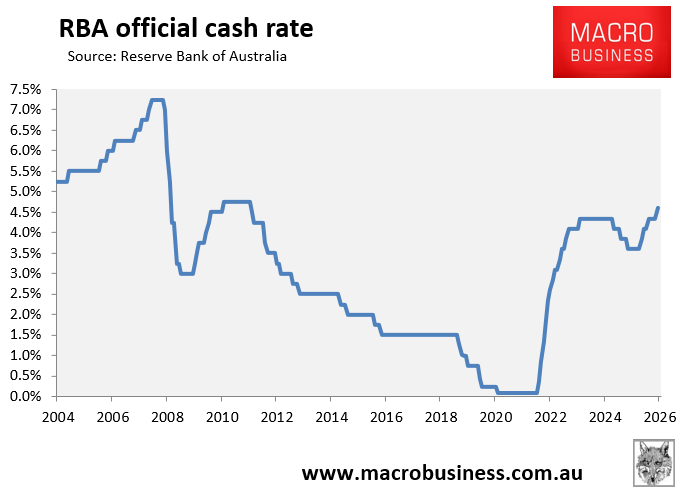
The minutes were decisively more hawkish than Governor Bullock’s unscripted media answers following the latest meeting, with a clear focus on upside risks to inflation and little attention given to downside risks to jobs and growth.
The minutes suggest the RBA increasingly believes that:
- Global inflation pressures from energy and AI-related investment are stronger than expected.
- Australia’s supply side is more constrained than previously thought.
- Productivity growth is too weak to allow inflation to return to target easily.
- A structural rise in neutral interest rates may mean monetary policy is less restrictive than headline rates imply.
On the second point, the minutes assess that the upside surprise in the July data “was more likely to reflect greater domestic capacity pressures than unexpectedly strong pass-through of cost increases flowing from the Middle East conflict”. Thus, the RBA increasingly believes higher inflation reflects domestically driven pressure rather than temporary global shocks.
Looking ahead, the Board believes that both domestic and global developments point to the risk of “persistently elevated inflation”.
At the same time, the minutes suggest the RBA Board isn’t worried about downside risks or weakness in some recent data, particularly the rise in the unemployment rate to 4.6% and the sharp decline in house prices and turnover.
The minutes also suggest the Board considered the 4.35% cash rate wasn’t restrictive enough, given higher global neutral interest rates, implying Australia’s neutral rate may also have risen.
“Members acknowledged that if the signals from financial markets of a potentially higher global neutral interest rate were correct, it would imply that the current cash rate target of 4.35% was less restrictive than it had been two years earlier”.
The Board explicitly stated that it is prepared to raise rates further if required, emphasising that inflation remains above target and that inflation expectations must remain anchored.
Therefore, further tightening remains on the table if inflation and capacity pressures do not ease as hoped.
Financial markets agree and have fully priced in one more hike from the RBA.