Several Australian journalists and economists have claimed this week that One Nation’s sensible proposal to reduce the stock of temporary migrants back to pre-pandemic levels would create skills shortages and worsen population ageing.
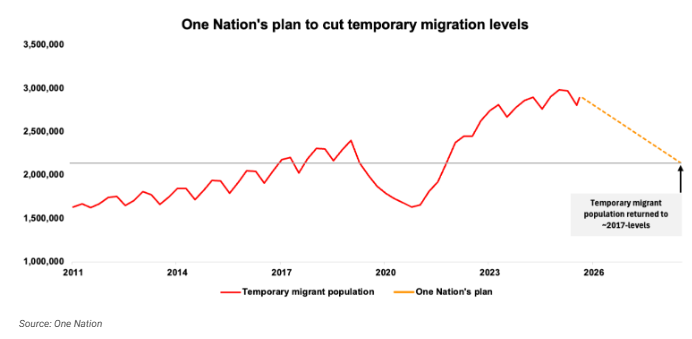
The following Tweet from journalist Hugh Riminton encapsulates this way of thinking:

The argument is as asinine as it is ignorant.
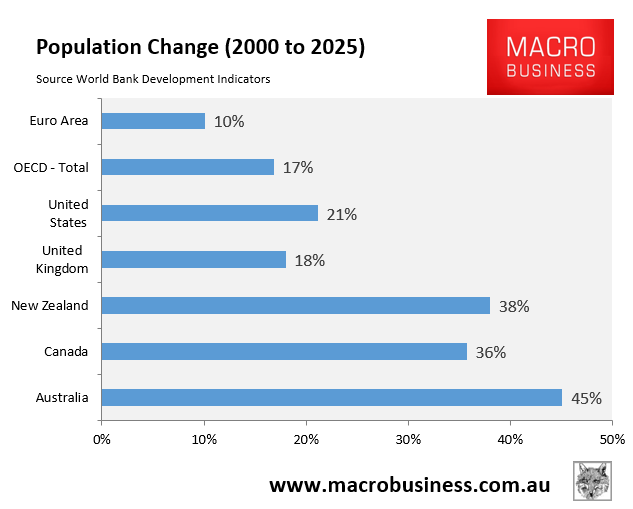
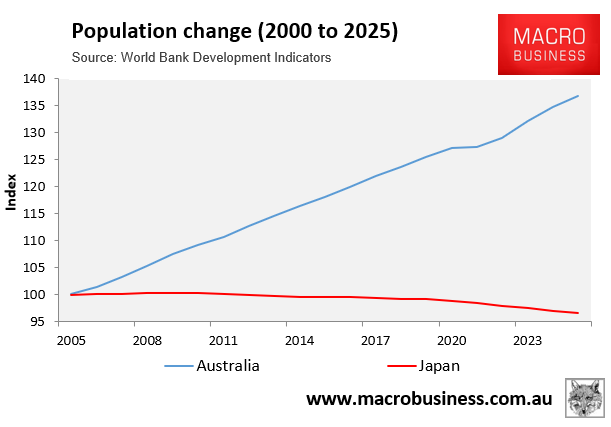
First, Australia’s population has grown at more than 2.5 times the rate of the OECD average since 2000, yet it suffers worse skills shortages than ever.
Second, a key driver of Australia’s population ageing is the waves of migrants who arrived in Australia in the 1950s and 1960s and are now old.
According to the Australian Institute of Health and Welfare, a federal government body, “over one-third (37%) of older Australians (i.e., 65 and over) were born overseas”.
The older population has a higher share of migrants (37%) than the Australian economy as a whole (32%):
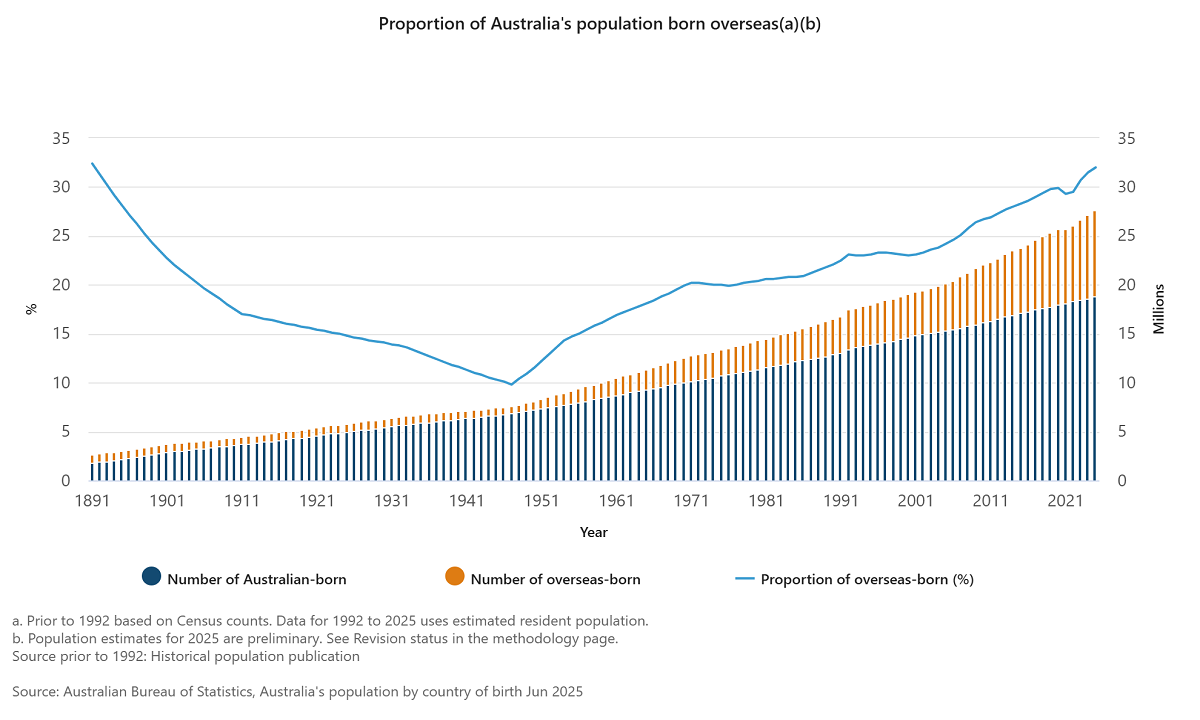
This suggests that immigration is a major driver of Australia’s ageing population.
Third, the notion that an ageing population is ‘bad’ for the economy is itself absurd. Dr Cameron Murray’s recent research showed that virtually every economy in the advanced world has a higher share of workers today than they did 40 years ago, despite rapidly ageing populations:
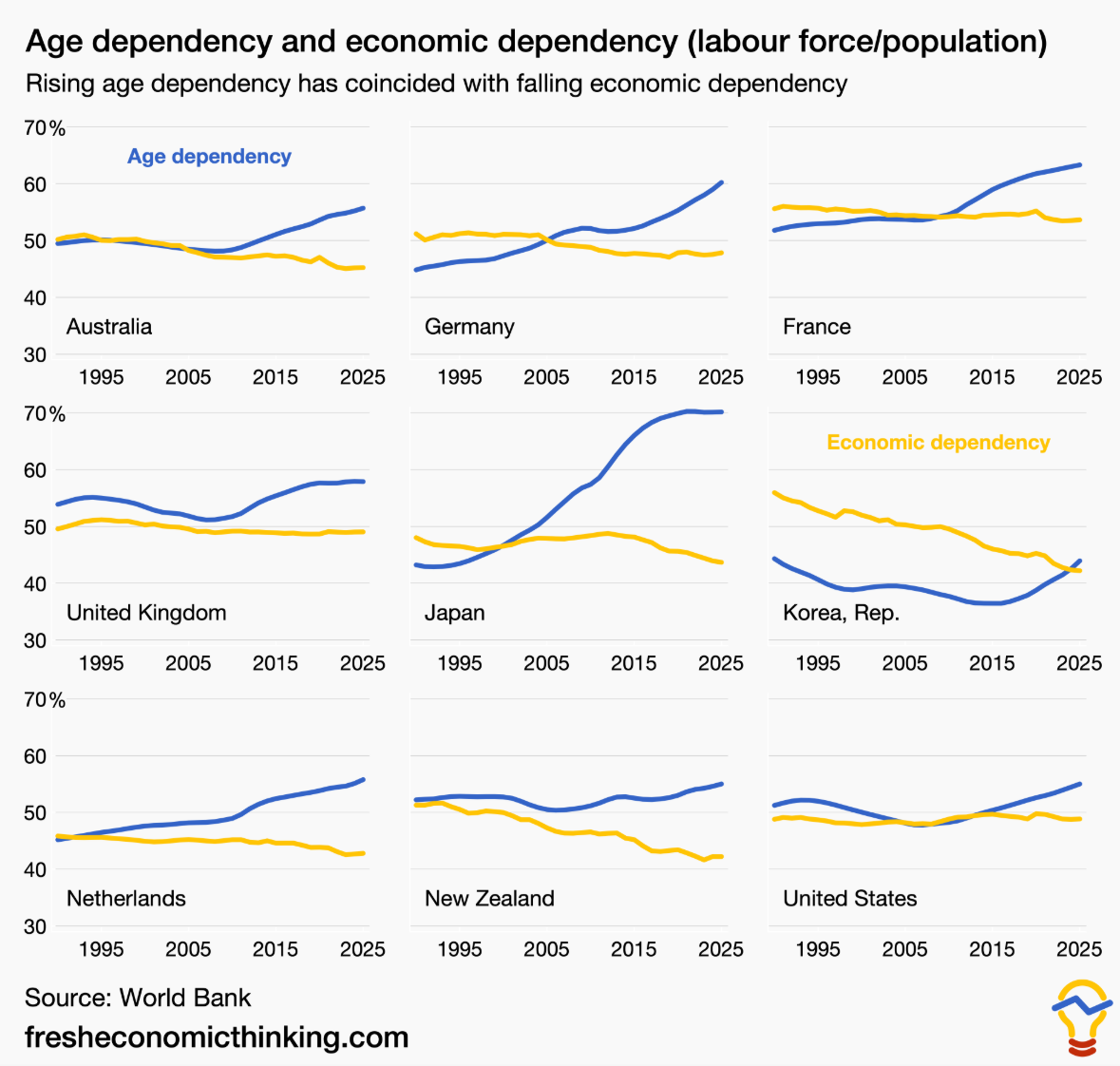
Moreover, despite decades of extreme immigration, Australia’s share of non-workers in the economy is no lower than in most other developed countries with significantly lower immigration intakes.
The contrast to Japan is especially startling.
Japan’s population today is smaller than it was two decades ago, whereas Australia’s population has exploded:
However, despite Japan’s shrinking population, a significantly higher share of people are working today than 40 years ago.
Moreover, Japan had a higher share of people working in 2025 (56%) than Australia did (55%):
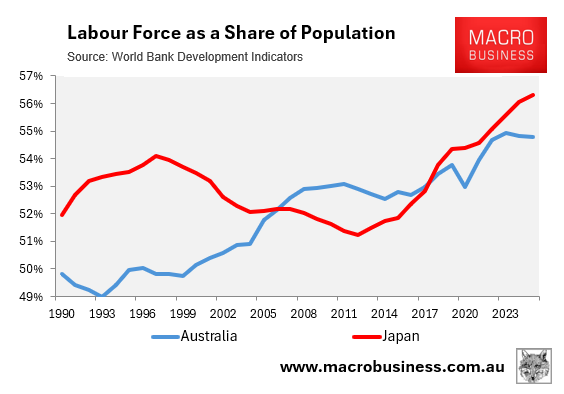
Thus, the World Bank data above thoroughly debunks the argument that Australia needs to run one of the world’s largest immigration programs to ensure it has enough workers.
Instead, Australia should seek to use its existing labour force more efficiently. An easy way to do so would be to abolish the income test for the aged pension to encourage more seniors to enter the workforce.
Under the current aged pension rules, people who are working and receiving the aged pension face effective marginal tax rates of up to 77%:
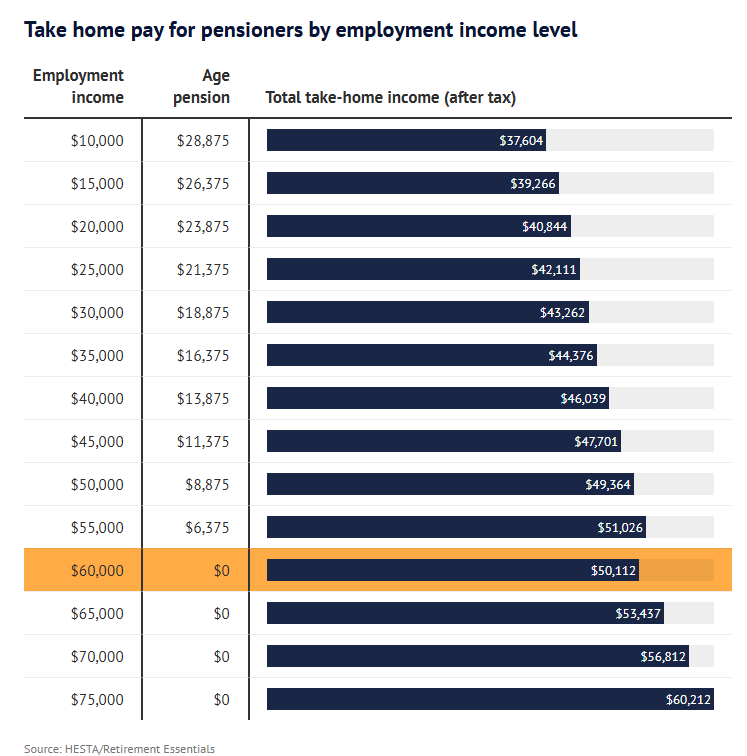
These high effective marginal tax rates discourage older Australians from working because for every extra hour they work in paid employment, they get taxed punitively because they lose access to the aged pension, so most don’t bother. It represents a massive disincentive.
New Zealand is a stark counterpoint to Australia.
New Zealand boasts one of the highest rates of workforce participation among those 65 and over in the OECD, a trend that has accelerated in recent decades.
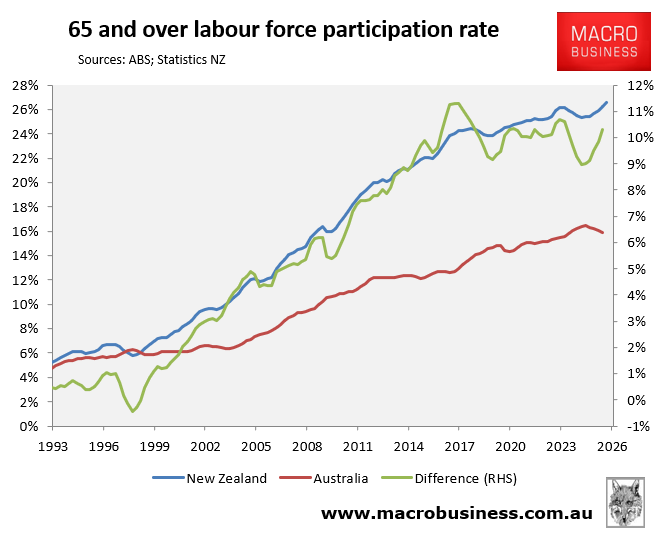
Data presented below from Statistics New Zealand’s Household Labour Force Survey (HLFS) shows that participation rates for those aged 65 and over have climbed from around 12% two decades ago to over 26% today. This isn’t accidental; the universal New Zealand Superannuation (NZS)—a non-means-tested pension providing financial security—enables many senior Kiwis to work by choice.
In other words, pensioners and veterans in New Zealand can earn income without their entitlements being clawed back.
Australia’s labour force participation rate for those aged 65 and over is just over 10% lower than New Zealand’s at 16%:
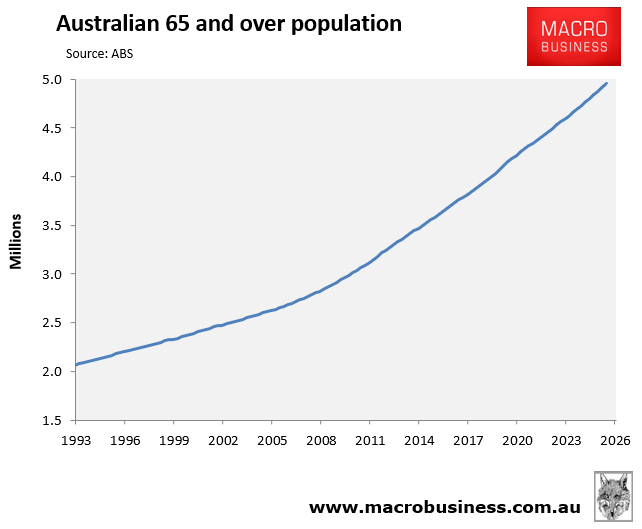
According to the Australian Bureau of Statistics (ABS), there were just under 5 million people aged 65 and over in Australia as of the March quarter of 2026, roughly double the number in 2002:
Australia should meet New Zealand halfway by maintaining the pension assets means test while eliminating the income means test. This would allow pensioners to work without incurring financial penalties. This is effectively One Nation’s policy.
The policy would likely be budget neutral or potentially positive, as standard income tax could then be levied on combined earnings from the aged pension and any income earned from work.
The following chart shows the additional 65-and-over workers that would be gained by the economy if Australia’s labour force participation rate matched New Zealand’s:
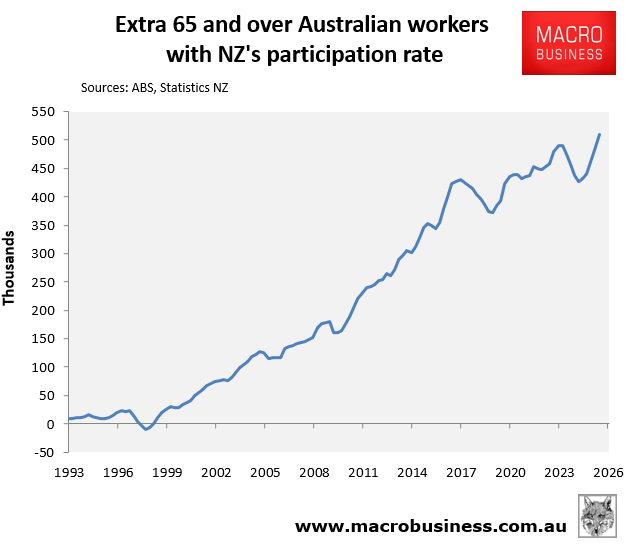
Australia would gain just over 500,000 workers if its 65-and-over labour force participation rate matched New Zealand’s, equivalent to just over 3% of the current labour force.
These people already live in Australia. Therefore, unlike new migrants, they will not place extra strain on housing, infrastructure, and services.
They would provide additional labour supply without increasing demand, bolstering the economy without the negative externalities that come with immigration-driven population growth.
Journalists like Hugh Riminton should lobby for practical policies like these rather than perpetuating myths about immigration solving population ageing and labour shortages.