Accounting firm EY has released its annual State Budget Monitor, which forecasts that state debt will continue to rise, led by Victoria.
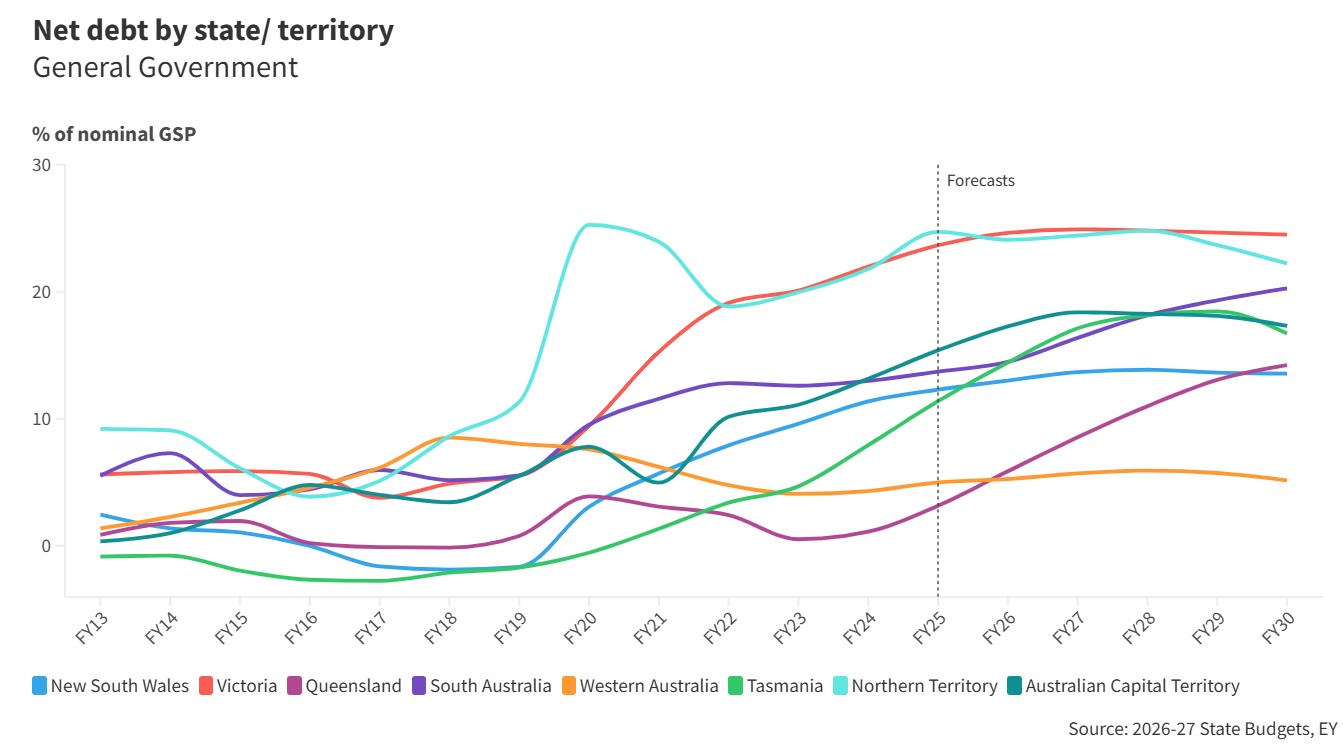
EY attributes part of the blow-out in debt to rising public servant wage costs, with growth in the number of public servants (29%) more than doubling the growth in the population (14%):
“Employee expenses accounted for an average of around 39% of total expenses from FY17 to FY26 and are one of the main reasons governments have consistently underestimated their outgoings”.
“The rise in general government employee costs reflects both higher numbers of government employees and wage increases”.
“From FY16 to FY25, the number of state and territory total public service employees grew by 29%, with the largest increase in the Australian Capital Territory (ACT), which grew by 49%. This was followed by Victoria at 40%, while the Northern Territory had the smallest rise at 15% over the same period”
“Strong population growth over recent years has been one of the drivers; however, government employee cost growth has been well above Australian population growth of 14% over the same period”.
“In addition, over the same period the average wages of state government public service employees rose by 33%, faster than the public sector wage price index growth of just over 26%. Queensland and Tasmania experienced the strongest rises, at around 40%”.
EY also remains unconvinced that the states can contain public servant wage costs.
“The 2026-27 state and territory budgets collectively forecast general government employee expenses to grow by an average of just 3.4% over the next four years, well below the long-run average rate of around 6.0%”.
“This reflects a continuing pattern of all states and territories underestimating employee expenses, evident throughout our analysis since 2015. The average forecast error rate across the states has ranged from 4.3% in New South Wales to 11.3% in Tasmania”.
“Realistic spending forecasts are critical so that fiscal pressures can be properly evaluated and decisions made to ensure budgets are sustainable”.
The reality is that Australia has transformed into an overly bureaucratic, low-productivity-growth economy driven by unsustainable government-funded employment and excessive lower-skilled immigration.
For the sake of budget sustainability, productivity, and living standards, the bureaucracy must be downsized.