I reported last week on The Age newspaper’s interactive tool showing what Melbourne will look like when its population soars beyond 10 million.
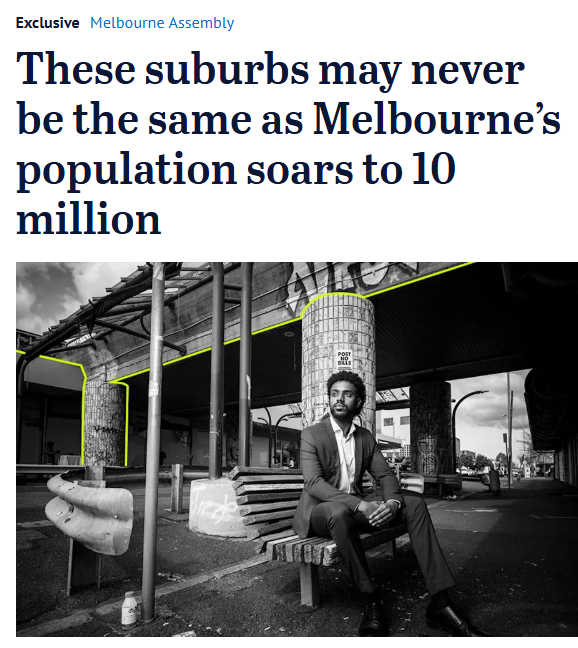
The modelling suggests that six activity centres will be denser than anything that exists in Melbourne today:
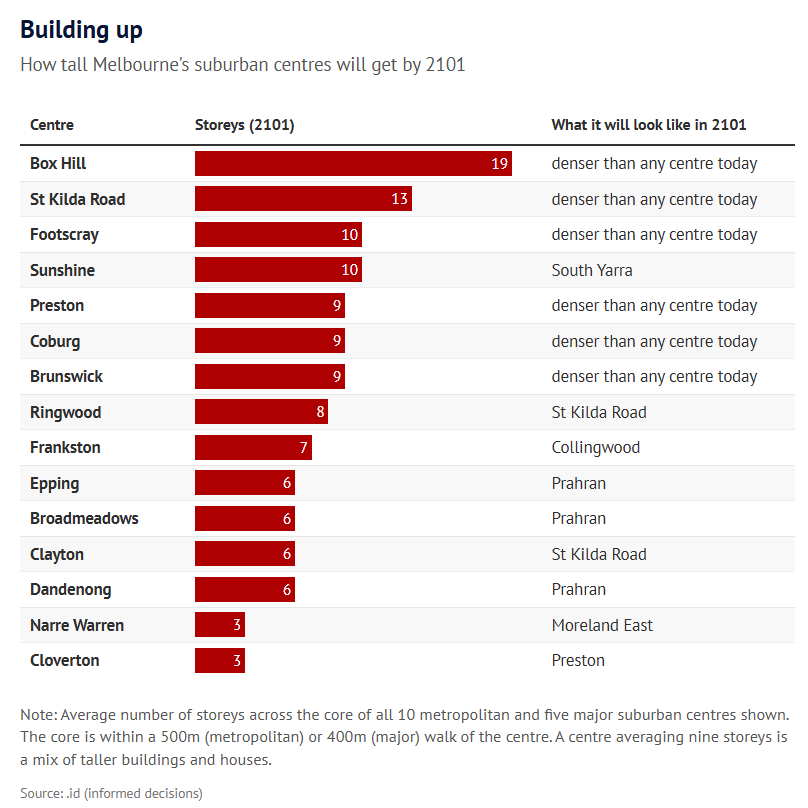
The number of dwellings across the top 15 centres is projected to massively increase under each development scenario – urban containment or expansion:
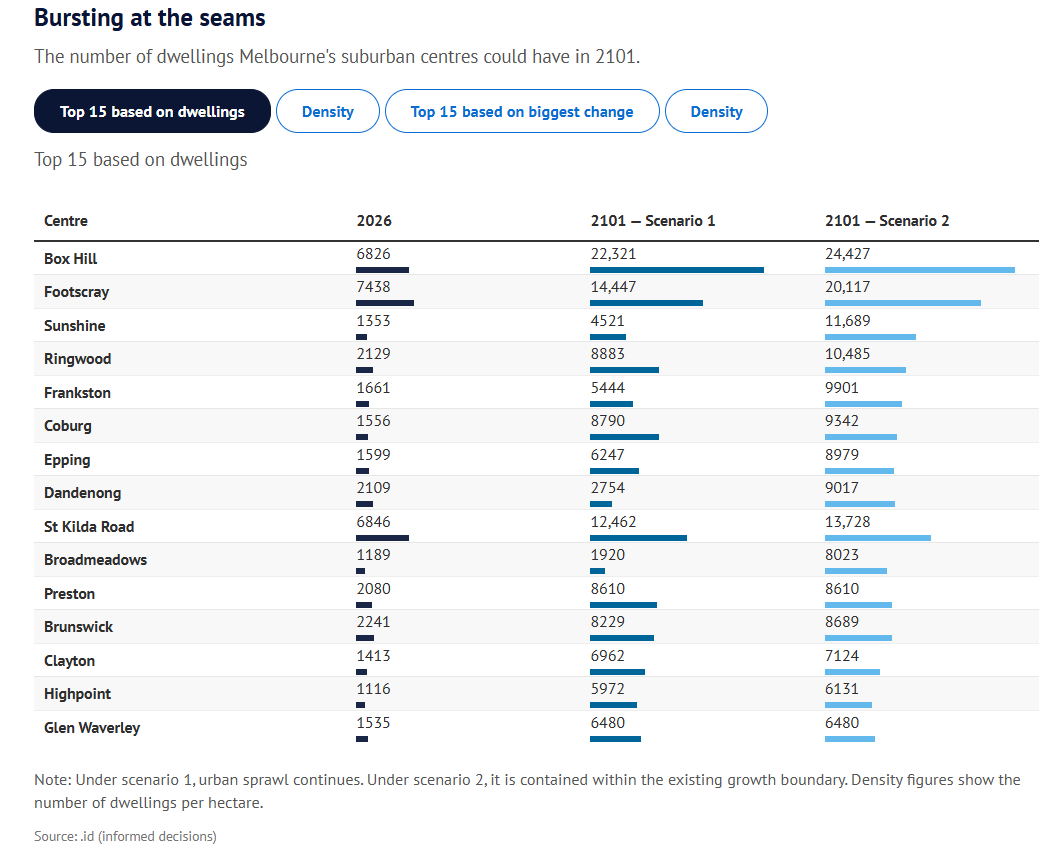
The question that everyone should be asking is, ‘Why is such growth for Melbourne viewed as inevitable?’
It took Melbourne 170 years to grow to a population of 3.7 million in 2005.
In 2003, the Australian Bureau of Statistics (ABS) released its Population Projections 2002 to 2101, which included a baseline (Series B) forecast of Australia’s population reaching 26.4 million by 2051, based on an assumed net overseas migration (NOM) of 100,000 annually.
The ABS projected Melbourne’s population to grow to 4.79 million by 2051.
In mid-2026, the ABS population clock put the nation’s population at 28 million, which is 1.6 million more than the ABS forecast for 2051.
Melbourne’s population is currently tracking at around 5.5 million, about 700,000 more than the ABS forecast for 2051.
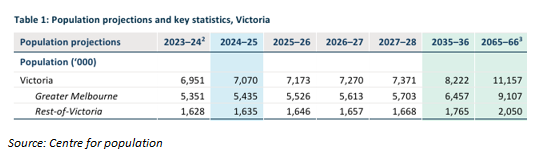
The Centre for Population’s latest forecasts for Melbourne have the city’s population hitting 9.1 million by 2065-66, 5.4 million (146%) greater than its population in 2005:
Such extreme population growth is highly problematic for living standards and the broader economy.
In 2005, Melbourne’s housing, infrastructure, water, and energy supplies had taken 170 years to build. The 146% projected expansion of the population in only 61 years would require these items to be more than doubled in a relatively short timeframe; otherwise, living standards will suffer.
Another by-product of the transformation into a megacity will be the death of the backyard. With geographical and planning constraints limiting Melbourne’s ability to expand outward, densification will intensify as the population balloons.
Mega-Melbourne is a giant parasite on Australia:
Aggressively expanding capital cities like Melbourne through continued mass migration will dilute the nation’s immense mineral and agricultural wealth, which is located in the regions, by spreading it among more people.
The economic reality is that Australia primarily finances its global presence through the sale of its fixed mineral endowment and agricultural goods. Ultimately, Australia’s exports pay for its imports.
According to the Department of Foreign Affairs and Trade (DFAT), 79% of Australia’s top 25 exports in 2024 were mining, commodity, or agricultural products produced in Australia’s regions.
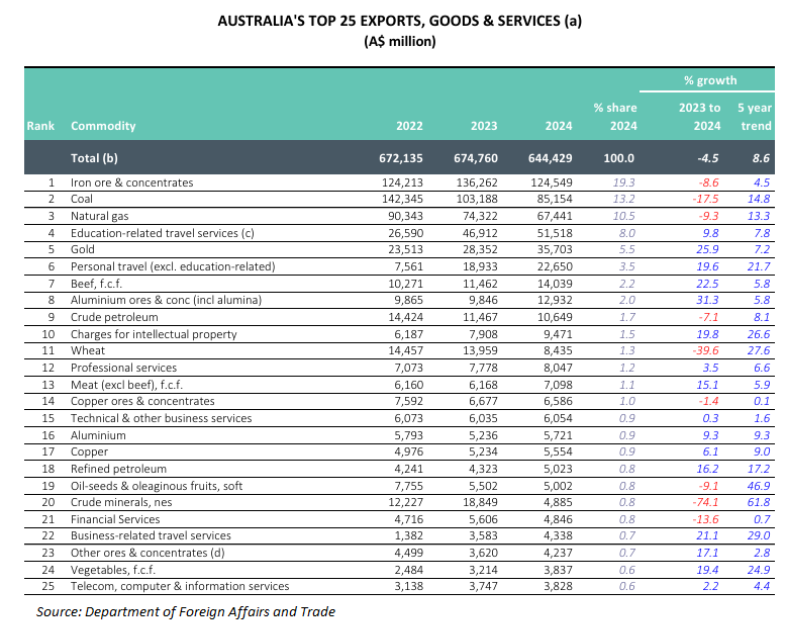
Demand for these products is exogenous, whereas their supply is highly capital-intensive and not dependent on high population growth from immigration.
Australia would ship roughly the same amounts of hard commodities and agricultural goods regardless of how many people arrive through immigration, as its productive capacity is already in place and does not require more labour.
The rapid expansion of Australia’s cities through immigration, therefore, negatively impacts the trade balance and current account, as it leads to a greater influx of imports than exports.
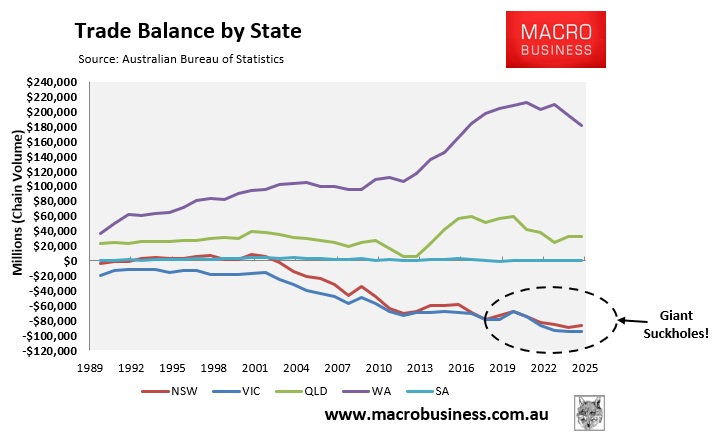
Victoria and, to a lesser extent, New South Wales encapsulate the economic downside of aggressively expanding Melbourne and Sydney through immigration. Together, both states have received around two-thirds of the nation’s net overseas migration over the past 20 years, mostly into Sydney and Melbourne.
This extreme level of immigration to Sydney and Melbourne has expanded imports in Victoria and New South Wales without materially increasing their exports (which are mostly generated in the regions).
As a result, both states have recorded substantial and growing trade deficits:
Regional Australia stands to lose from continual mass migration into the cities, as capital cities will gain political clout and influence vis-à-vis the regions, and neglect of Australia’s regions will inevitably worsen as they lose political influence.
The regions’ share of seats in the federal parliament will shrink, diluting their representation and the political weight of regional versus metropolitan Australia.
As a result, the regions will be deprioritised for infrastructure, services, and industry support.
By pursuing large-scale immigration, Australia’s policymakers have chosen to worsen the nation’s trade balance and destabilise the regions politically by aggressively expanding the capital cities and imports.