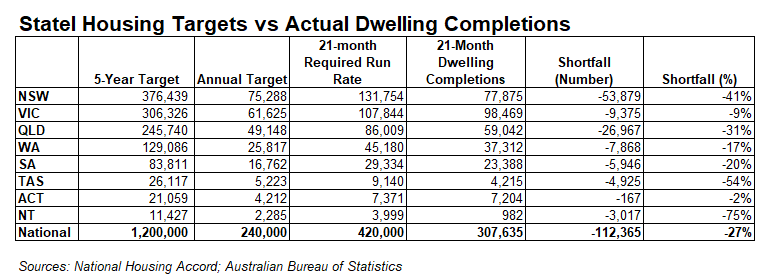
The National Housing Accord’s target of building 1.2 million homes over five years, or 240,000 annually, is falling way behind, with only 307,635 dwellings completed over the first 21 months of the Accord, 112,365 (27%) fewer than the run rate required to meet the target.
The Albanese government hoped that the federal budget’s changes to negative gearing and capital gains tax (CGT) would help stimulate construction by encouraging investors to purchase newly built dwellings over established ones.
Under the changes, investors will only be able to negatively gear if they purchase or build a new home. Investing in a newly constructed home will also give them the option of applying the old 50% CGT discount or the new CGT indexation method.
However, the sharp decline in dwelling values, driven in part by the changes to negative gearing and CGT, is having the opposite effect of stifling new home construction.
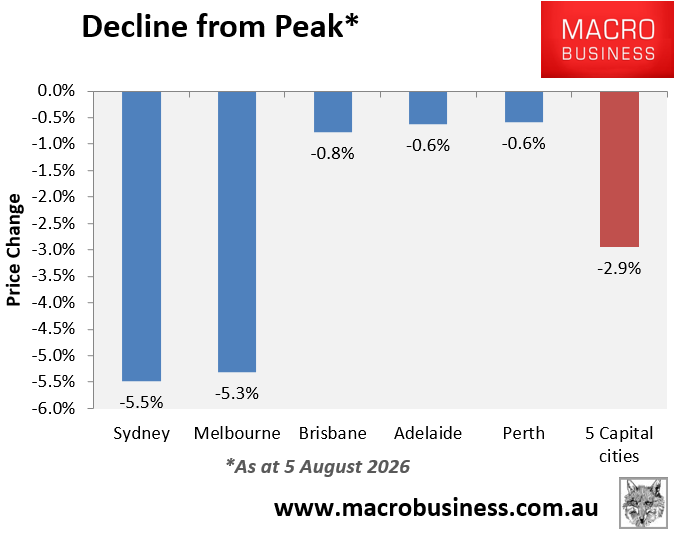
Tim Gurner, one of the nation’s largest apartment developers, told The Australian that the declining property market, driven by the government’s investor tax changes, was making it almost impossible for small to medium operators to get housing projects off the ground.
“Right now you’ve got sentiment problems, you’ve got debt problems, capital problems, construction issues”, Gurner said. “It’s never been harder to develop residential real estate. What we’re seeing in the market now with clearance rates and pricing, that’s not a fundamental real estate issue; that is purely a sentiment and sentiment of fear that has been created by the government”.
“It is saying directly to the government: your policies will limit supply. That’s as simple as that”, he said.
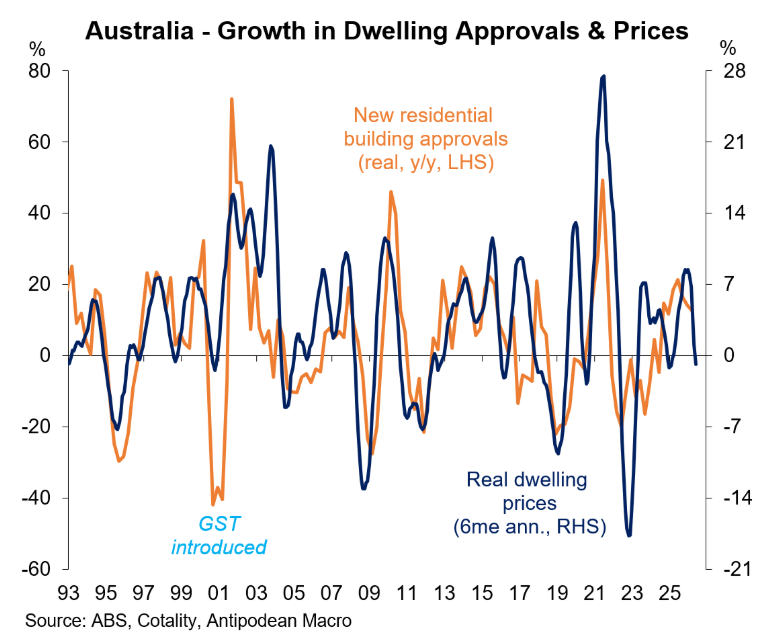
In a cyclical sense, Gurner is not wrong. As illustrated below by Justin Fabo from Antipodean Macro, dwelling approval rates tend to be correlated with prices. Therefore, the prospect of a severe price correction portends a lower rate of construction ahead.
The reality is that Australian homebuilders are facing a perfect storm of headwinds that are working against higher construction.
In addition to falling prices, interest rates are elevated, making it harder for developers to finance projects and lowering borrowing capacity for buyers.
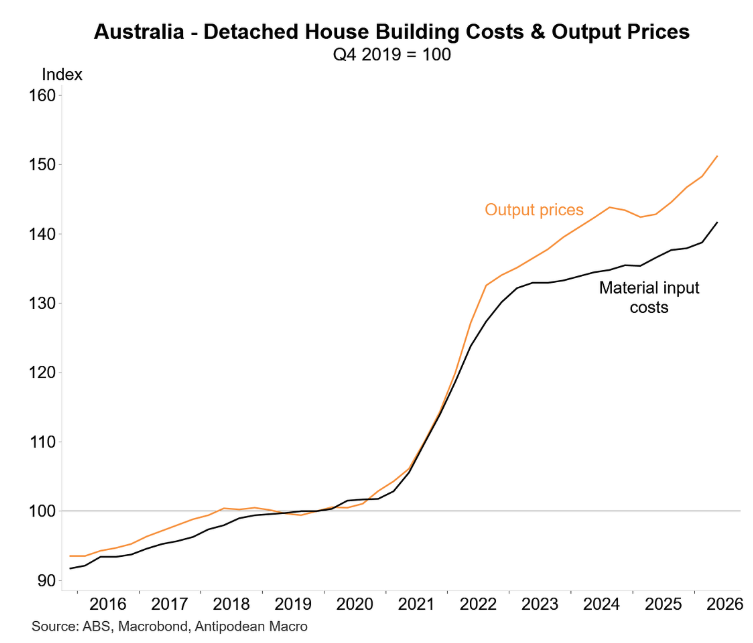
Construction costs continue to rise, and the war in the Middle East is making them worse.
Insolvencies in the construction sector also remain historically high.
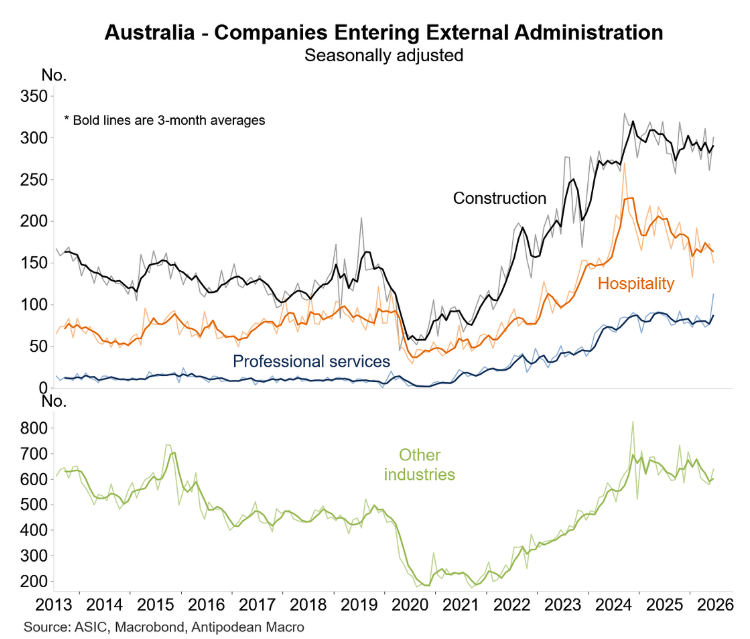
With the supply side of the housing market remaining constrained for the foreseeable future, the only realistic way to ‘solve’ the housing shortage is to reduce immigration, as Canada has done.