The single most pressing issue facing the Australian economy is poor productivity growth.
Australia has ranked among the poorest in the OECD over the past decade on labour productivity growth.
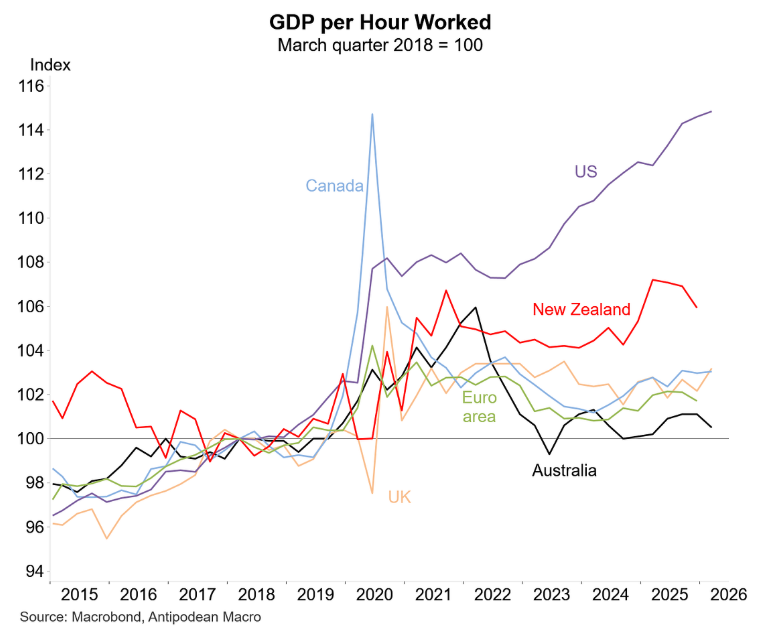
Chart by Justin Fabo at Antipodean Macro
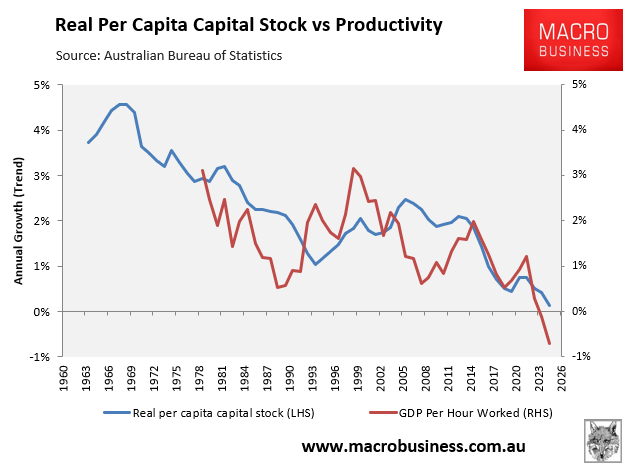
‘Capital shallowing’ is one reason for Australia’s poor productivity growth. Put simply, the nation’s population has expanded faster than business, infrastructure, and housing investment, resulting in less growth in capital per worker.
The explosive growth in the non-market sector, driven in part by the expansion of the NDIS, where labour productivity hasn’t grown for 25 years, also helps to explain Australia’s productivity slump:
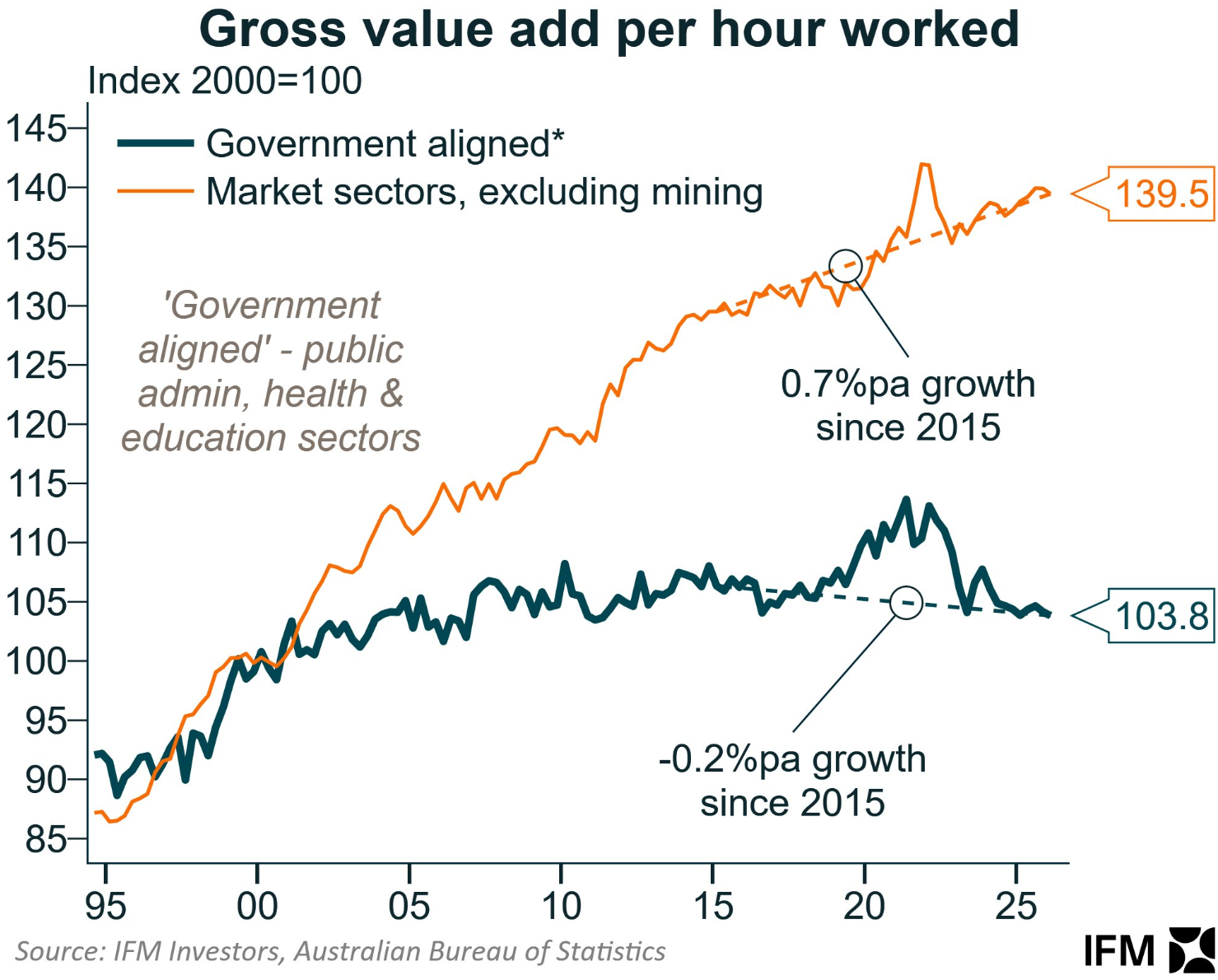
Chart by Alex Joiner at IFM Investors
The upshot is that Australia’s poor productivity growth has made the economy increasingly reliant on population growth via net overseas migration to drive GDP growth.
The following chart shows how the share of Australia’s GDP growth derived from productivity growth (i.e., earned) halved between the 1990s and 2020s:
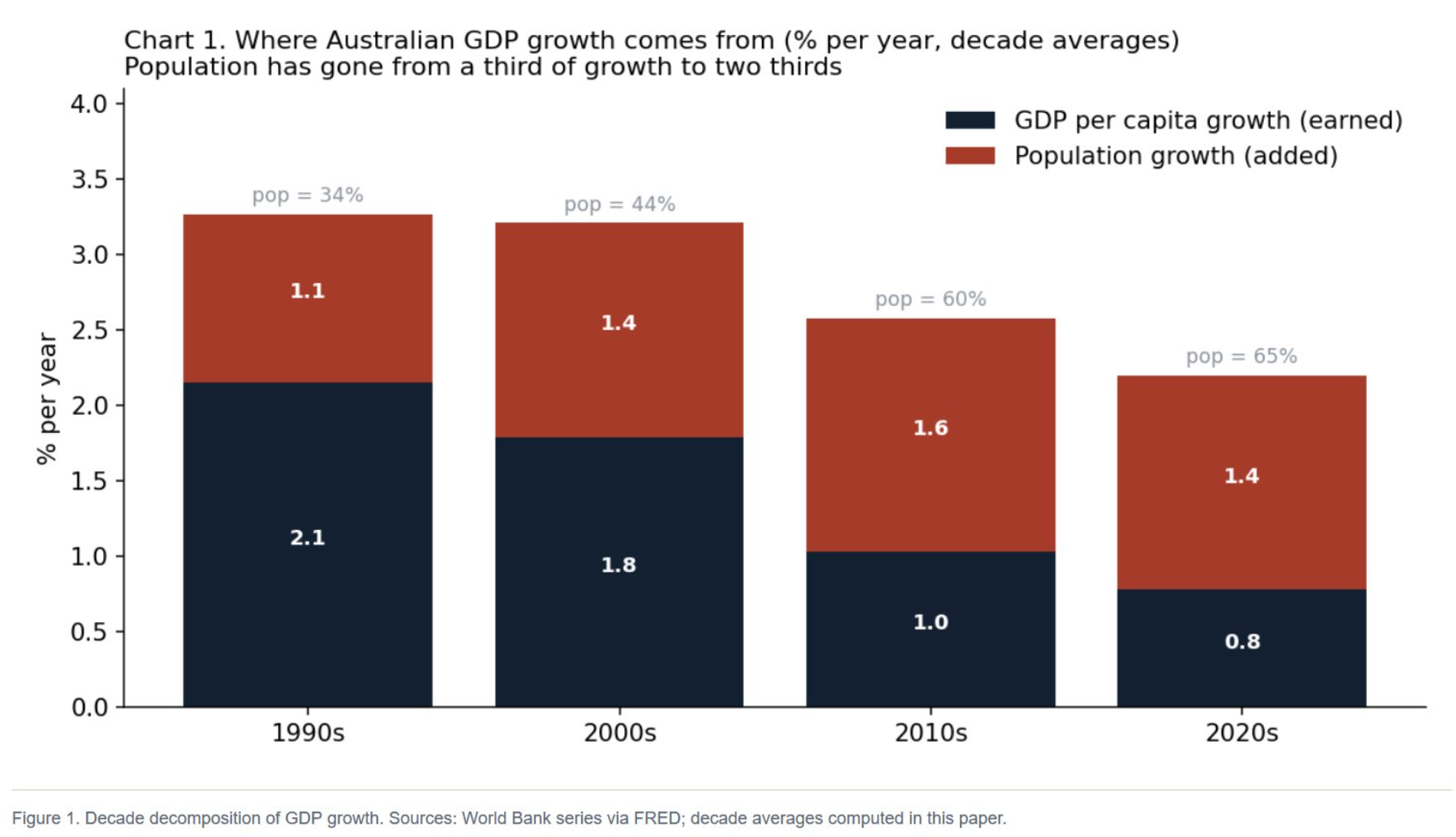
The situation has worsened following the COVID-19 pandemic, with almost all of Australia’s GDP growth derived from population growth (i.e., immigration) rather than productivity growth:
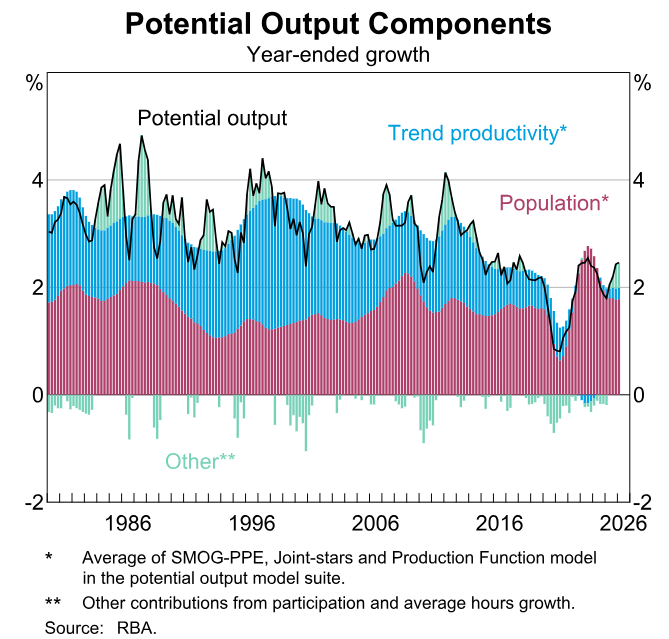
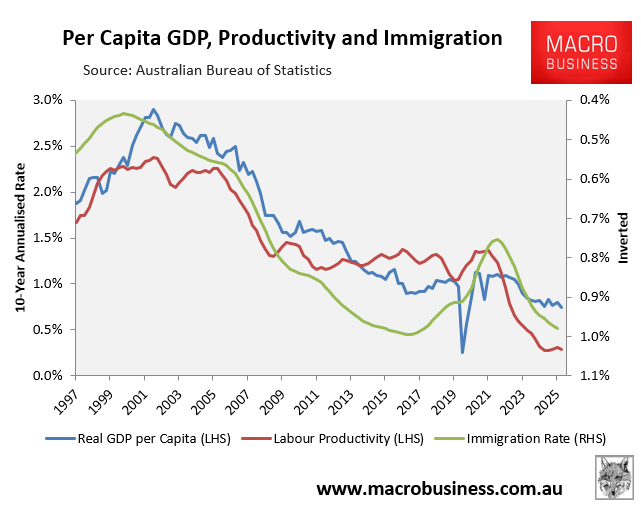
The Australian Treasury’s “Three Ps” of productivity, participation, and population have largely been replaced by “One P”: population growth through immigration.
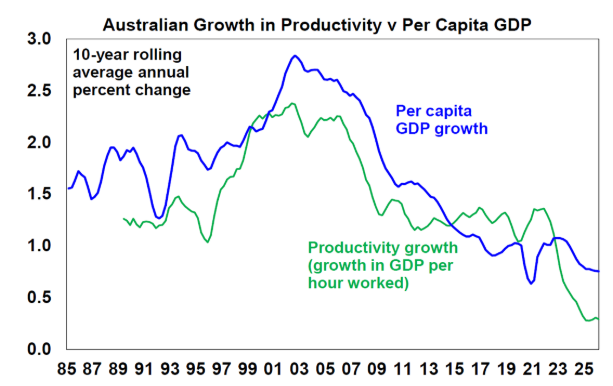
As a result, per capita growth and living standards are stuck in the low growth zone and won’t improve until productivity does.
Shane Oliver dissects the productivity problem:
Shane Oliver, chief economist at AMP, has published an excellent report showing how the collapse in Australia’s productivity growth has negatively impacted living standards.
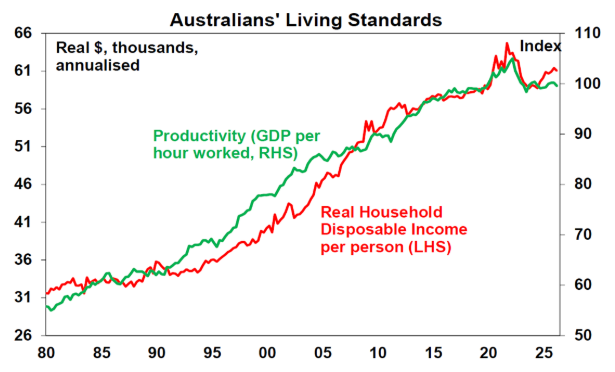
Oliver shows that real household disposable income per capita has fallen by around 9% since 2021 and remains 5.6% below its peak.
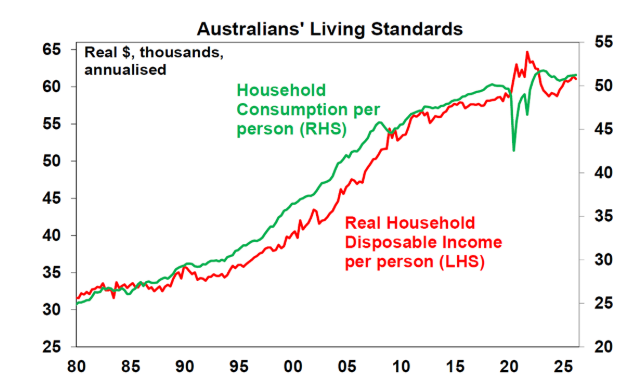
Source: Shane Oliver (AMP)
Australia’s growth in real gross disposable income per capita since 2007 has also been well below the OECD average:
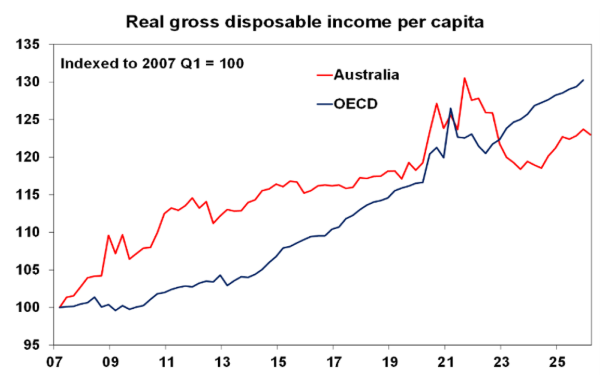
Source: Shane Oliver (AMP)
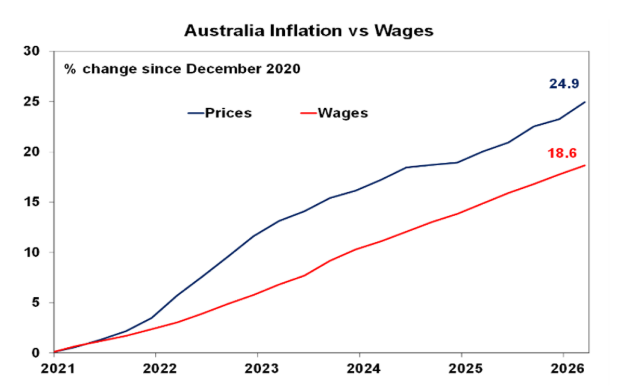
Real wages have also declined by around 6% because inflation (up 25% since 2020) has outpaced wage growth (up 19%).
Source: Shane Oliver (AMP)
Australia’s real wage decline is among the worst in the OECD.
Interest rate hikes since 2022 sharply increased mortgage payments as a share of income, lowering disposable income. Bracket creep has also pushed income tax to near-record highs.
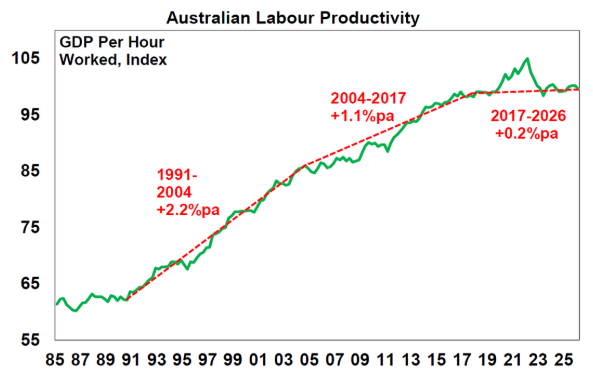
However, the structural decline in productivity growth is the major cause of Australia’s slump in disposable income.
Productivity growth averaged more than 2% per year in the 1990s but has fallen to near zero since 2016.
Source: Shane Oliver (AMP)
“Productivity growth is the main driver of material living standards over long periods. As can be seen in the next two charts, the slowdown in productivity points to ongoing softness in per capita GDP growth”, notes Oliver:
Source: Shane Oliver (AMP)
“…and slower growth in household incomes and by implication consumer spending”.
Source: Shane Oliver (AMP)
“We can make up for this by faster population growth, but this doesn’t help living standards per person”, notes Oliver.
“Lower productivity growth makes it harder to boost the supply side of the economy to keep inflation down and results in lower real wages growth, slower growth in profits and a reduced ability for the government to provide services”.
The causes of Australia’s productivity malaise:
Shane Oliver identifies a range of causes for Australia’s productivity malaise, including:
- Stalled economic reform — no major reforms since the GST in 2000; some areas have re‑regulated.
- Rapid population growth — worsening congestion and housing affordability.
- Weak business investment throughout the 2010s.
- Increased market concentration — less competition, slower innovation.
- Climate policy uncertainty — underinvestment in energy supply, higher energy costs.
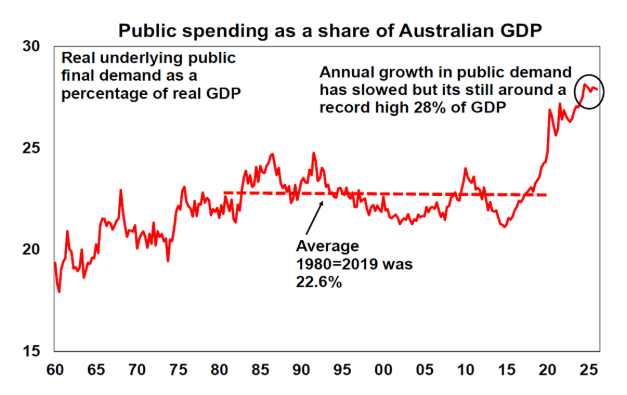
- Huge expansion of public spending, especially the NDIS, health and aged care, and public sector employment.
“The surge in public final demand – which is now running around 28% of GDP compared to an average of around 22.6% over the previous 40 years – is particularly significant, as the required shift in resources from the private sector to the public sector has been bad news for productivity”, notes Oliver.
“That is because public (or non-market) sector productivity is invariably lower than that in the private (or market) sector and because public spending has been squeezing out private business investment, which has weakened private sector productivity”.
Source: Shane Oliver (AMP)
A stagflation economy emerges:
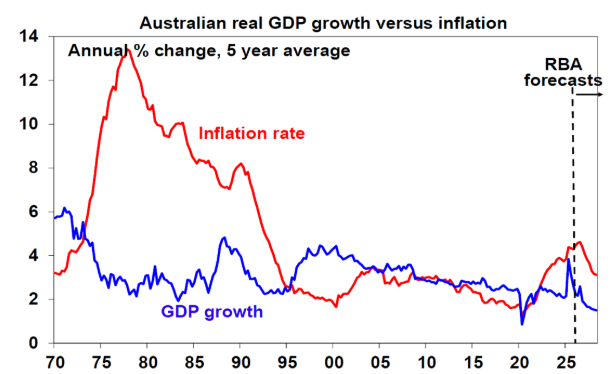
Another byproduct of Australia’s productivity slump is that it has driven inflationary pressures, despite weak GDP growth.
“The deterioration in productivity growth has effectively led to a worse growth/inflation trade off”, notes Oliver.
“In other words, because the economy is no longer as efficient as it uses to be in boosting the supply of goods and services to meet any pick up in demand (or spending) in the economy – as we saw last year when private sector demand picked up – an acceleration in growth is more likely to result in a higher rate of inflation than used to be the case for any given level of GDP growth”.
Source: Shane Oliver (AMP)
How to fix the productivity problem:
Oliver argues Australia needs a new reform agenda focused on:
- Tax reform
- Reducing the size of the public sector
- Deregulation
- Incentives for private investment
- Competition reforms
- Clearer climate/energy policy to support investment
- Matching population growth to the ability to supply new homes and making it easier for people to live away from congested cities.
These suggested reforms are aimed at restoring productivity growth, which is the primary driver of long‑term living standards.