The rise in consumer spending is a major factor behind the Reserve Bank of Australia’s monetary tightening, which has delivered three 25 bp rate hikes this year.
The latest Household Spending Insights (HSI) from CBA, which is based on de-identified payments (i.e., credit card, debit card, keypad transactions, ATM, BPAY, Buy Now Pay Later and direct debit transactions) and home lending data from approximately 7 million CBA customers, showed that spending growth slowed materially in June:
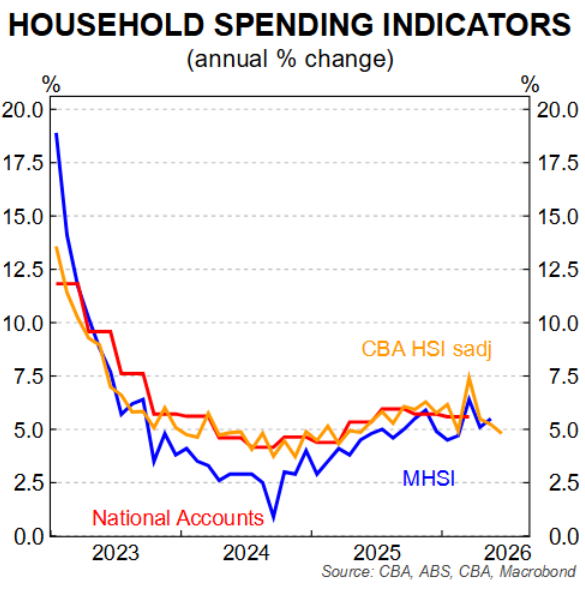
“The softening we are seeing in the CommBank HSI is broadly in line with our expectation that household spending will slow over the remainder of this year”, CBA’s Head of Australian Economics, Belinda Allen, said.
“Slower household income growth, together with the ‘wealth effect’ from a downturn in the housing market, is expected to weigh on spending. However, consumers may dip into their savings buffers, which would see spending slow less than we expect”.
However, while overall household spending appears to be moderating, retirement-aged Australians, who are largely insulated from rising mortgage rates and rents, continue to spend freely and have actually increased their spending compared to last year.
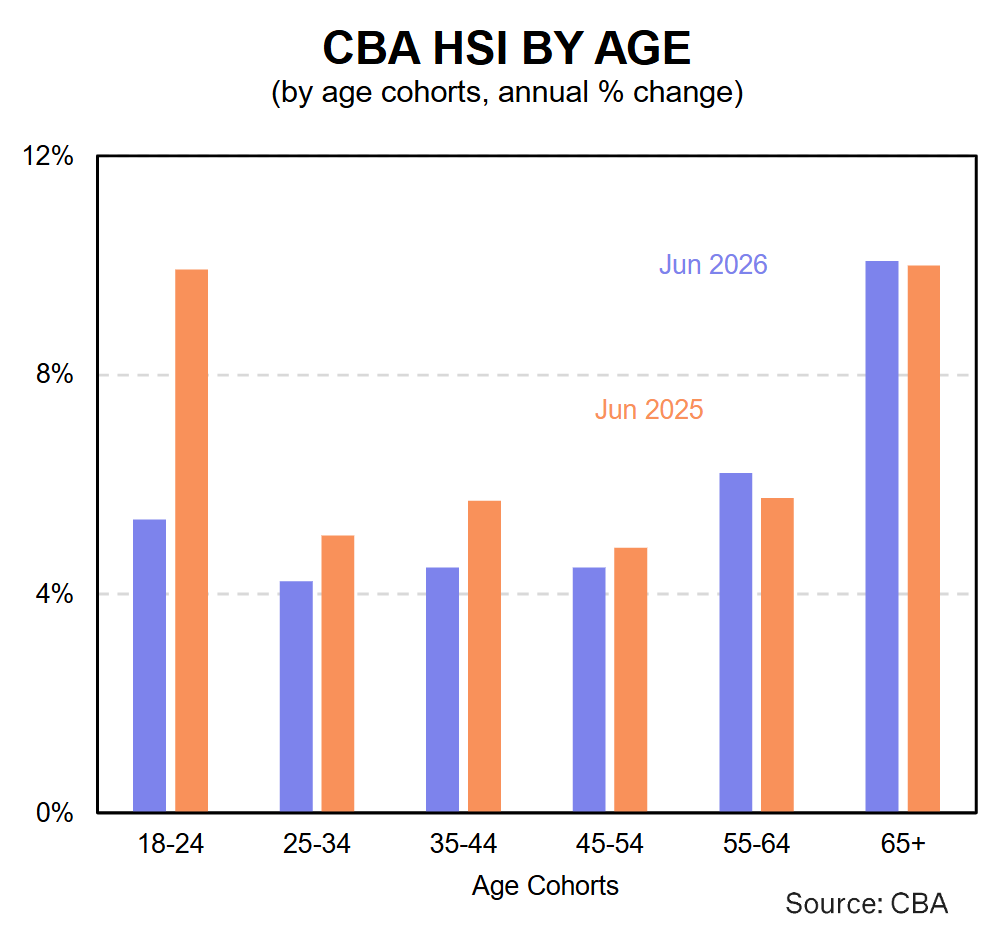
“Shifts in interest rates, inflation and wealth affect age cohorts differently, which can lead to varying rates of spending growth”, CBA noted.
“In the 12 months to June 2026, spending growth was strongest among consumers aged 65+, up 10.1%/yr. The 55–64 cohort also recorded solid growth, up 6.2%/yr, while spending among 18–24 year-olds rose 5.4%/yr”.
“Growth was softer across the middle-age cohorts, with spending up 4.5%yr for both 35–44 and 45–54 year-olds, and just 4.2%/yr higher for 25–34 year-olds. These groups are more likely to have a mortgage, making them more sensitive to higher interest rates”.
Baby boomers are the least impacted by the recent rise in rents and mortgage payments because most own their homes outright.
Many of these cohorts have also benefited from increased investment returns.
Therefore, while younger Australians have mostly cut back on nonessential spending, older Australians continue to spend freely.
In turn, their spending is helping to drive up inflation and working at cross-purposes with the RBA.