OECD data shows Australia has one of the highest income‑tax burdens on average workers in the developed world.
Meanwhile, tax receipts from indirect sources like excises are shrinking as consumers shift to untaxed illegal tobacco and electric vehicles.
Australia’s consumption taxes via the GST are also relatively low compared with OECD peers.
This leaves personal income tax as the fiscal anchor of the federal budget. It also means that with an ageing population, a declining share of workers is being slugged harder to fund government spending.
New analysis from the Parliamentary Budget Office (PBO) shows that total revenue is projected to increase from 26.4% of GDP in 2026-27 to 27.4% in 2036-37, driven by rising personal income tax receipts.
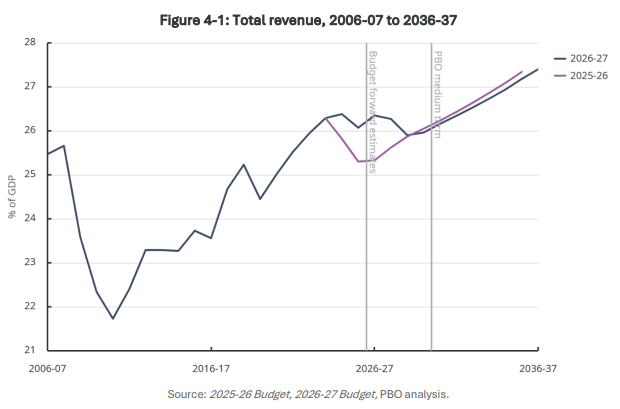
“Projected revenue growth over the medium term is predominantly driven by personal income taxes, the only source of revenue projected to increase materially as a share of GDP (see Figure 4-2), from 12.6% of GDP in 2026-27 to 14.8% by 2036-37″, the PBO notes. “Much of this projected growth can be attributed to bracket creep”.
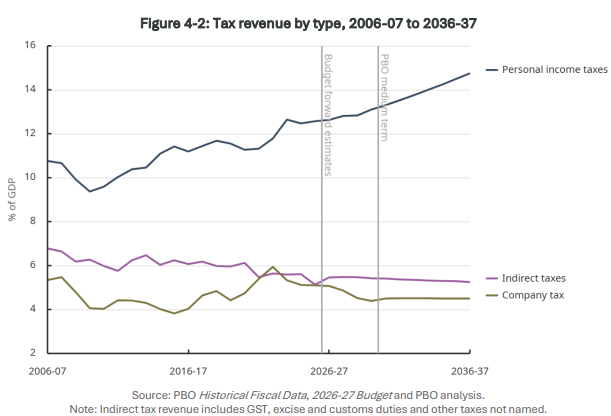
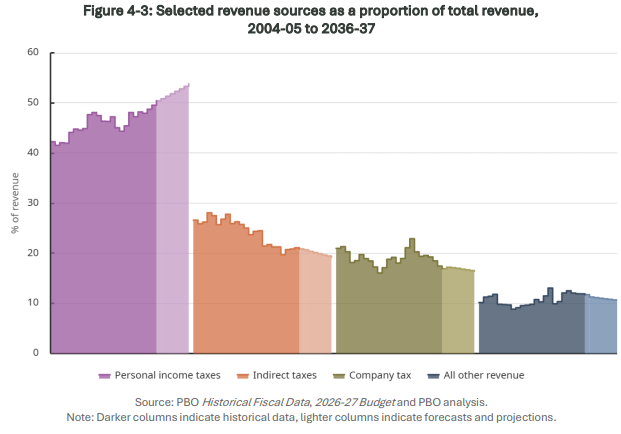
“Personal income taxes are projected to continue to grow faster than the economy over the medium term, while all other major sources of revenue remain broadly flat (Figure 4-2). As such, personal income taxes will make up half of total revenue by 2029-30 and 53.8% of total revenue by 2036-37, decreasing the share of other revenue sources (Figure 4-3)”.
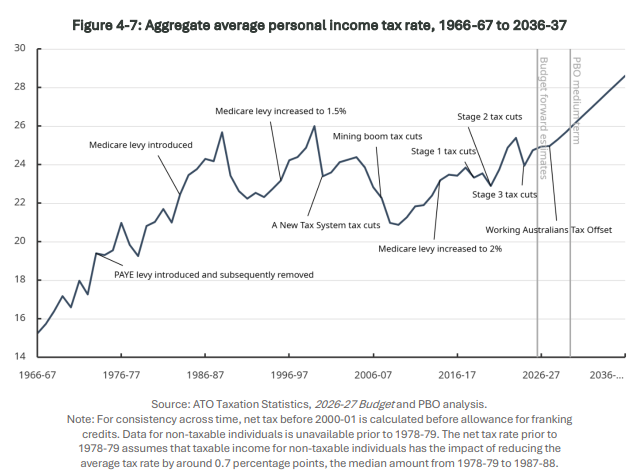
“In the absence of further announced personal income tax policy, the PBO projects that average tax rates will continue increasing from 24.9% in 2026-27 to a historical high of 28.6% by 2036-37, mostly driven by bracket creep (Figure 4-7)”, the PBO notes.
The PBO also cautions that indirect tax receipts are falling, which is increasing the reliance on personal income taxes to fund the federal budget:
“Indirect taxes are also projected to decline from 5.5% of GDP in 2026-27 to 5.3% by 2036-37, driven primarily by excise revenue declining from 1.3% to 1.1% of GDP over this period”.
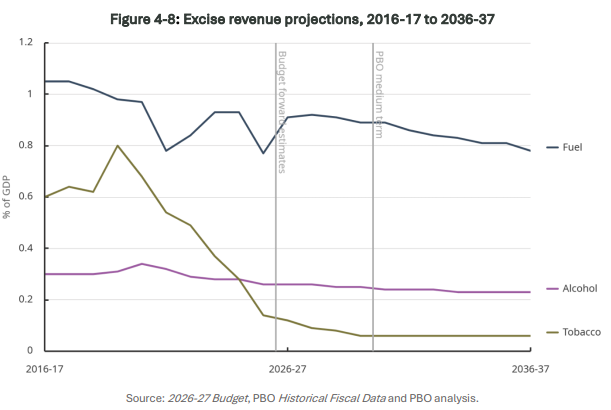
“Following Federation in 1901, excise taxes comprised most of the Commonwealth’s revenue. However, their contribution has been in long-term decline, shrinking from around 2.6% of GDP in 2006-07 to a projected 1.3% of GDP by 2026-27. This trend is expected to continue over the medium term (Figure 4-8) as contemporary economic and social developments continue to undermine the tax base for all forms of excise, with total excise revenue expected to decline further from 1.3% of GDP in 2026-27 to 1.1% of GDP in 2036-37”.
“Fuel excise makes up a majority of excise revenue, expected to be around 71% in 2026-27, and is the largest contributor to its decline over the medium term, projected to fall from 0.91% of GDP in 2026-27 to 0.78% by 2036-37. This is driven by the increased adoption of electric and hybrid vehicles, creating a long-run structural decline in fuel usage and fuel excise revenue. The CSIRO projects that more than one-quarter of cars in Australia are likely to be electric by 2036-37″.
“Tobacco excise is the fastest declining excise tax relative to its size, projected to halve over the medium term as a share of GDP, from 0.12% of GDP in 2026-27 to 0.06% of GDP by 2036-37. Tobacco excise has been used as a policy lever to significantly increase the cost of legal tobacco with the aim of reducing consumption. However, this has led to a significant shift from legal to illicit tobacco consumption in Australia – estimated at around 80% of all consumption in 2025 – and resulting in a sharp drop in tobacco excise revenue”.
“In addition to this decline, tobacco excise has also been the dominant driver behind subsequent downwards revisions in excise revenue. Between the 2023-24 Budget and 2026-27 Budget, estimates of total excise revenue for 2026-27 have been revised down by $11.1 billion, from $52.1 billion (1.7% of GDP) to $41.0 billion (1.3% of GDP). These revisions were driven almost entirely by tobacco excise which, over this same period, was also revised down by $11.1 billion, from $14.7 billion to $3.6 billion.
“Alcohol excise is projected to experience the smallest decline over the medium term, from 0.26% of GDP in 2026-27 to 0.23% of GDP in 2036-37. This is driven by the declining consumption of alcohol on a per capita basis”.
The above data from the PBO highlights why Australia desperately needs a comprehensive tax reform package that broadens the base and shifts the burden away from productive effort.
A broad-based package should include a combination of reduced federal spending (funded by cutting the bureacracy), income tax cuts, measures to improve the interplay between the tax and welfare systems, broad-based land taxes, consumption taxes, unwinding inefficient and inequitable tax concessions, rationalisation of state and federal taxes, further measures to prevent multinational tax avoidance, and company tax cuts in exchange for better resource taxation.
The important thing is that the package is comprehensive, broadening the overall tax base and building it around more efficient and equitable sources.
The 2010 Henry Tax Review wrote the template. It merely needs to be dusted off, updated, and implemented.
To do nothing and rely on never-ending increases in personal income tax via bracket creep, while the base of workers shrinks as the population ages and the proportion of retirees rises, is inefficient, inequitable and unsustainable. It would ultimately lower Australian living standards, especially for the younger generations, whose tax burden rises inexorably.