

With the war in the Middle East still unresolved and growing domestic inflationary pressures, concerns continue to mount about the future of the Australian economy.
Back in May, RBA Assistant Governor Sarah Hunter delivered a speech, during which she put forward the RBA’s perspective that a significantly more serious downturn within the economy and labour market deterioration could be necessary to combat inflationary pressures.
“Moreover, if (inflation) expectations rise persistently, it becomes harder for the central bank to bring inflation back to target, as it must both bring expectations back down and restore the balance between supply and demand”.
“Doing so may require a more substantial slowing of economic activity, as we saw during the early 1990s recession (Graph 6 below). So it’s crucial for central banks to keep inflation expectations anchored around the inflation target.” Hunter said.

When assessing the performance of the economy through the lens of the latest Household Spending Indicator data from the Commonwealth Bank, it’s clear that the consumer economy has begun to slow.
Given the current circumstances, which are defined by three rate rises from the RBA this year, continuing uncertainty stemming from the crisis in the Persian Gulf and the potential impact of the recent federal budget, it’s rather unsurprising.
That being said, as the chart below of real per capita household spending indicates, the deterioration in the consumption growth of the nation’s households actually began late last year, long before the conflict in the Middle East had began.
Brief side note: The temporary surge in spending in March was largely due to the dramatic increase in the cost of petrol and diesel stemming from the war in the Middle East.
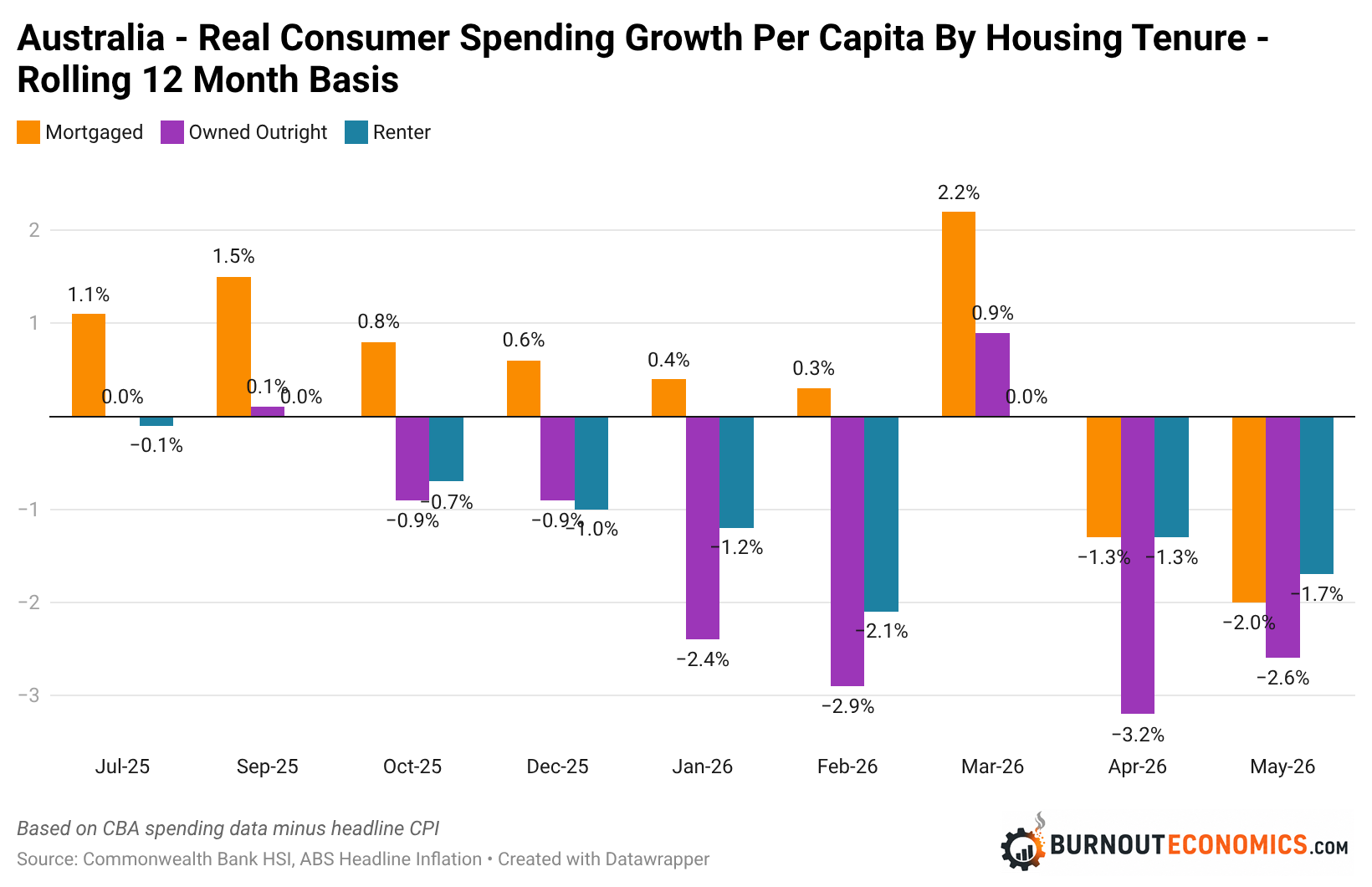
Since the war driven boost in spending, the trend has deteriorated further, with all cohorts as defined by housing tenure now seeing their per capita spending falling in real terms.
One of the most concerning scenarios is that the current downturn in real per capita consumer spending does not tame inflation, after all, real spending has fallen significantly on multiple occasions since the pandemic, but inflation has never been sustainably tamed.
Between Q1 2022 and Q2 2025, real per capita household spending (excluding housing) declined in aggregate terms, with the declines occurring entirely in the under 55 demographic.

Since the RBA’s preferred inflation metric (the trimmed mean) first went past the RBA’s 2% to 3% target band in Q1 2022, it has had just two quarterly inflation reports under 3%.

The Takeaway
Taking a step back and assessing the broader picture, it is unfortunately all too similar to much of the post pandemic era, real household spending at a per capita level is deeply weak and underlying inflation remains too hot for comfort.
Despite years of households making sacrifices through reduced consumption, the underlying conditions of the economy and settings from policymakers have ensured that inflation remains a major issue.
Amidst the fragmentation of the landscape of federal politics and the rise of One Nation, further declines in consumption and real wages could be fertile ground for these trends to continue.
Ultimately, the challenging conditions being experienced by households have been heavily influenced by a series of failed policy choices from both sides of federal politics, who chose to pursue a series of strategies that temporarily boosts headline GDP growth, but at a cost of a blow to growth in living standards in the long term.
