

Recently, there has been a great deal of debate over the path of Australia’s population growth, most notably regarding what Australia’s population will look like in the year 2100.
In a recent commentary to the Daily Telegraph, entrepreneur and former retail magnate Dick Smith warned that:
“We’re going to get to (a population) 100 million by 2100, when our grandchildren will still be alive”.
“One hundred million is a ridiculous number for a dry country like Australia”.
Swiftly, a chorus of dissenting viewpoints emerged on social media, claiming that Smith’s figure was overstated.
For example, ANU researcher Dr Liz Allen had this to say on the subject on social media platform X:
“No, Dick, projections for 2100 show Australia’s population will reach 43.1 million, not your ridiculous figure. Please stop with the scaremongering.”
In her tweet, Allen shared a report from the federal government’s Centre for Population detailing the U.N. forecasts behind the figure.
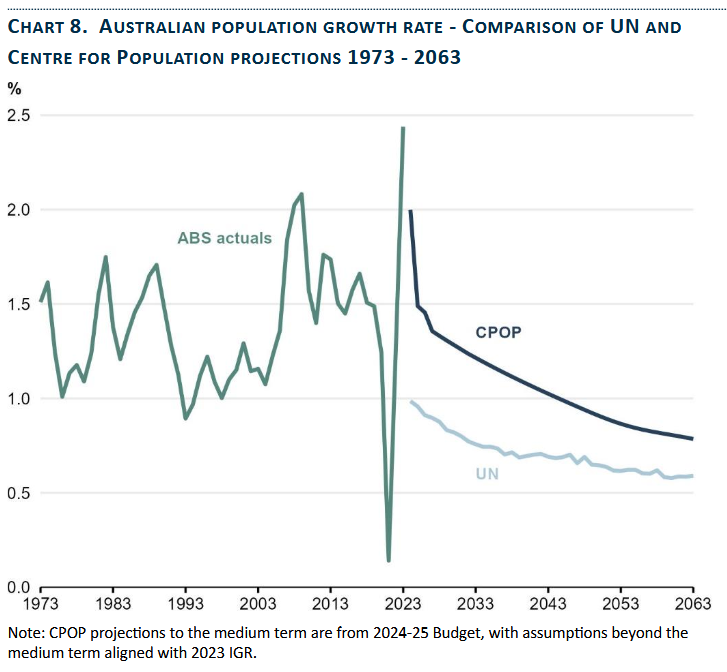
However, the Centre for Population went on to note in their report how divergent their forecast was from their forward estimates compared with the United Nations.
“The Centre for Population (CPOP) is forecasting significantly higher growth in the Australian population (Chart 8). The Centre for Population forecasts a population of 40.7 million people by 2063, in comparison to 35.2 million in the UN series.”
The major point of divergence is in the words of the Centre for Population, “due to different overseas migration assumptions, particularly in the 2020s”, noting that “The Centre for Population and the UN fertility and mortality assumptions are nearly identical”.
Here is a copy of the chart referenced in the quote, showing a major divergence in population growth rates over the duration of their estimates.
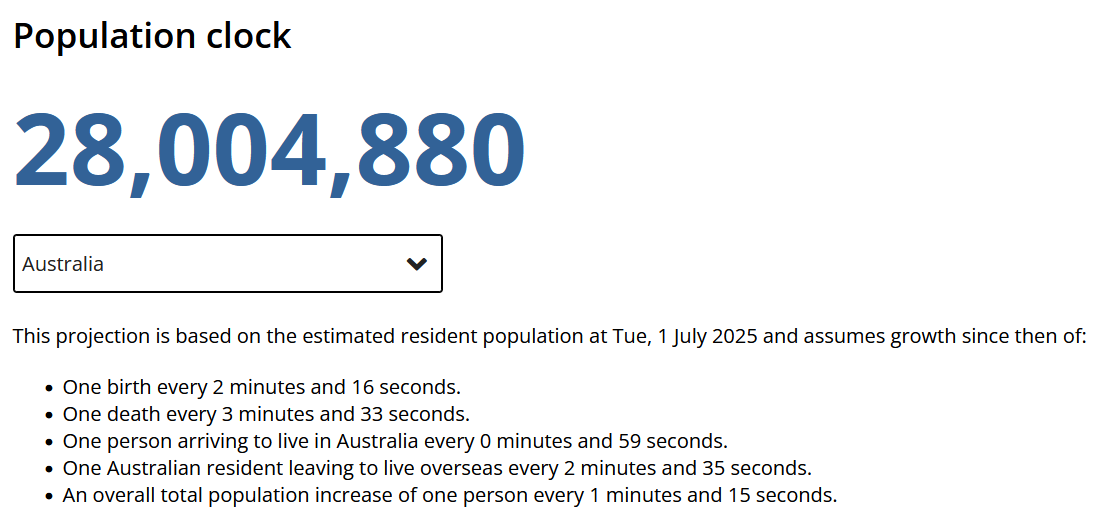
But what would growth in the population look like if the current settings were maintained? That is, if the current proportional growth rate derived from the underlying numbers which define the ABS Population Clock were continued in perpetuity.
Currently, the growth rate laid out by the ABS Population Clock is equivalent to just a fraction over 1.50% per year.
If we somewhat crudely take that figure of 1.50% growth and extrapolate it out to the year 2100, as other estimates have, we arrive at a population figure of 84.37 million for that year.
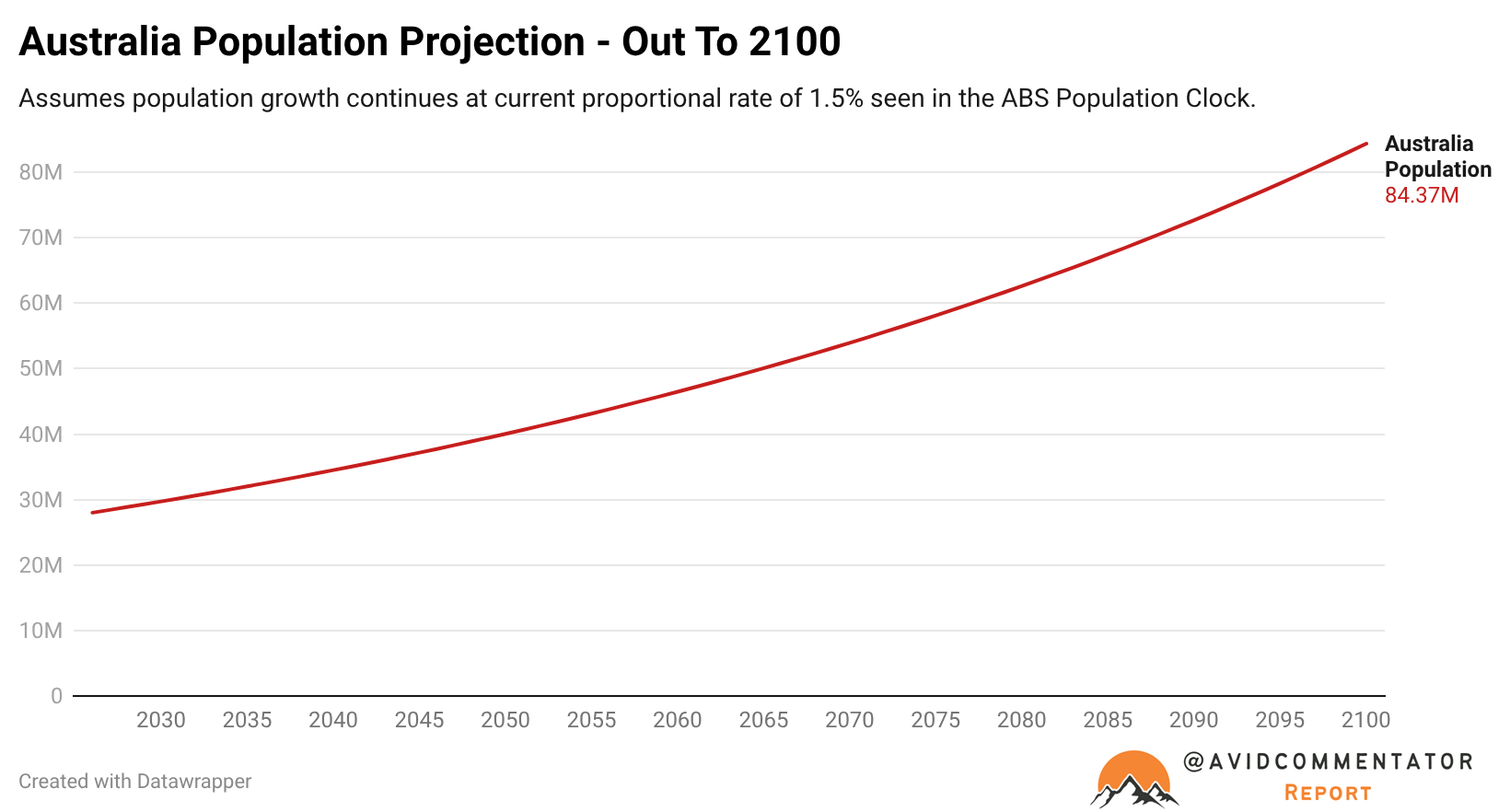
While one hopes that this figure will be far off the figure arrived at in reality, it wouldn’t take many years of outsized migration across the next four decades to arrive at the population figure of 48.6 million in 2063 instead of the 40.7 million estimated by the Centre for Population.
After all, this would not be unprecedented.
In the 2003 Intergenerational Report, it was estimated that under the high life expectancy scenario, we would reach a population of 28 million in the year 2051.
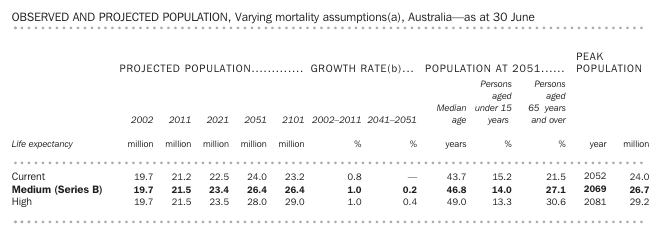
According to the ABS Population Clock, we recently reached that figure a full quarter of a century earlier than expected.
Ultimately, the settings of the migration intake are not what they were historically.
Instead of a system that delivered measured migration of a cohort of individuals who in aggregate boosted productivity and helped to deliver some of the most broad-based prosperity in human history, we have a system that, by the government’s own admission, does not boost productivity and has “marginal economic benefit”.
Unfortunately for Australians, the government’s assessment of the impact of the current migration system is likely an extremely optimistic one.
