Following a strategic review of the student visa program in 2011 (the “Knight Review”), the Gillard Labor government significantly enhanced employment rights for graduate (485) visas in 2013.
In particular, 485 visa holders are not required to meet skills shortage requirements and may stay in Australia for two to four years after finishing their studies, compared with the prior 18 months.
In contrast to temporary skilled shortage (TSS) work visas, holders of graduate (485) visas are:
- Not required to be qualified for any of the jobs on the Skilled Occupation List.
- Does not require a solid offer of employment from a firm.
- Not required to receive a minimum rate of pay.
- Don’t have to find a job that matches their qualifications or requires a specific degree of expertise.
- Visas remain valid even if they are unable to find work.
The Knight Review strongly advocated expanding post-study work rights (PSWR) to significantly boost Australia’s appeal as a destination for international students and to help Australian universities and employers.
Australia’s graduate (485) visas are now regarded as among the most appealing worldwide, granting full employment rights. They are also highly coveted by international students, as they are viewed as a path to permanent residency.
Jobs & Skills Australia’s (JSA) International Students Pathways and Outcomes Study, released in August 2025, provided clear evidence that international students increasingly view Australian student visas as a pathway to long-term residency and that quality and integrity problems in the current system are undermining both student outcomes and Australia’s skills strategy.
JSA explicitly noted that “nearly 70% of international higher education students reported that the possibility to migrate was a reason for choosing to study in Australia, rising to 77% of Indian and 79% of Nepali higher education students”.
JSA reported that students increasingly choose courses, providers, and locations based on perceived pathways to permanent residency rather than educational value.
Low-skilled and underemployed:
Temporary Graduate visa holders are now the largest group of long-term temporary labour migrants and are intended to be a source of skilled workers.
However, the federal government’s 2023 Review of the Migration System explicitly noted that “international students struggle with the transition into the labour market post-study and are often employed below their skill level” and “many perform poorly”.
The Review found that three years after graduating with a bachelor’s degree, just over half (51%) of all graduate visa holders end up in jobs at the lowest 2 skill levels despite being qualified for top levels (versus 20-30% for domestic students).
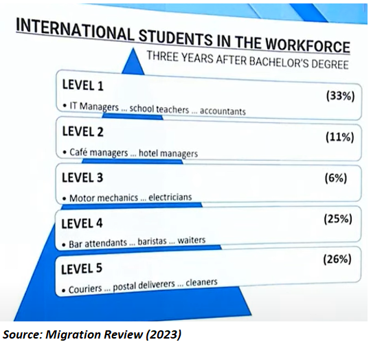
“Former students are among the largest cohort of ‘permanently temporary’ migrants”, the Review noted.
The 2024 Graduate Outcomes Survey is equally damning. It revealed that international graduates have significantly lower full-time employment rates across undergraduate and postgraduate courses.
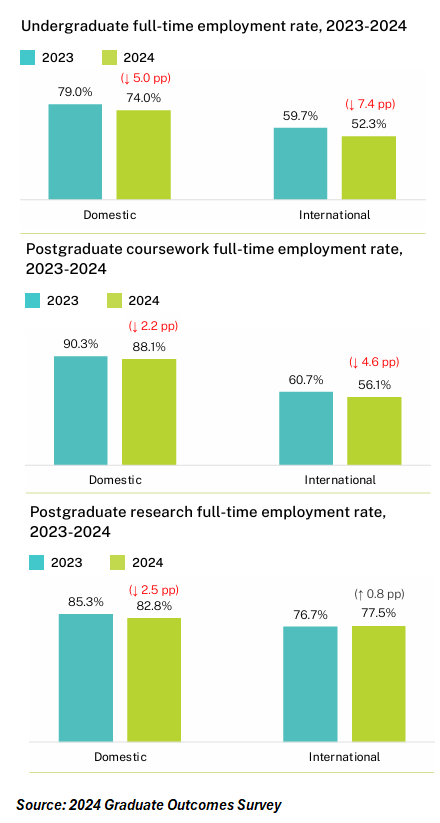
International graduates in full-time employment were also less likely than domestic graduates to hold a managerial or professional occupational-level role, except at the postgraduate research level. For undergraduates, 63.2% of international graduates and 68.7% of domestic graduates were in such roles in 2024. For postgraduate coursework graduates, 63.8% of international graduates were in these roles, 22.4% lower than domestic graduates.
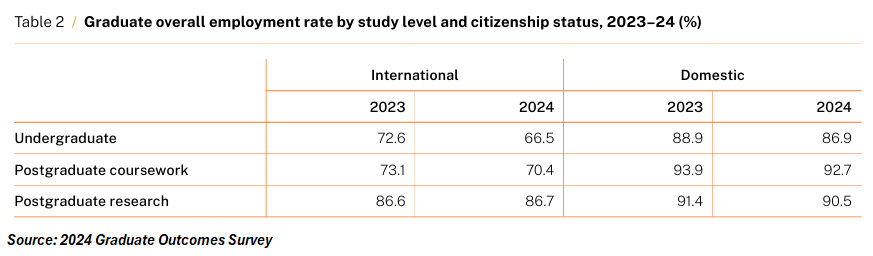
The unemployment rates of international graduates are significantly higher than those of local graduates. In 2024, 33.5% of international undergraduates were unemployed, compared with only 13.1% of domestic undergraduates. 29.6% of international postgraduates (coursework) were unemployed in 2024, versus 7.3% of domestic postgraduates (coursework). 13.3% of international postgraduates (research) were unemployed in 2024, versus 9.5% of domestic postgraduates (research).
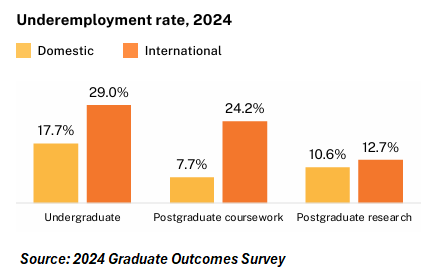
The underemployment rate of international graduates is also materially higher than that of domestic graduates. In 2024, 29.0% of international undergraduates were underemployed, versus 17.7% of domestic graduates. The gap widens for postgraduates (coursework), where 24.2% of internationals were underemployed in 2024 versus 7.7% of the domestic cohort. The gap narrows for postgraduates (research), where 12.7% of internationals were underemployed, only slightly more than the domestic cohort (10.6%).
Finally, the 2024 Graduate Outcomes survey revealed that the median salaries of international graduates are significantly lower than those of their domestic counterparts. Domestic undergraduates were paid $7,000 (10.3%) more than international undergraduates in 2024. The gap widens for domestic postgraduates (coursework), who were paid $30,000 (43%) more than their international counterparts in 2024. Domestic postgraduates (research) were paid $8,800 (9.2% more) than their international counterparts in 2024.
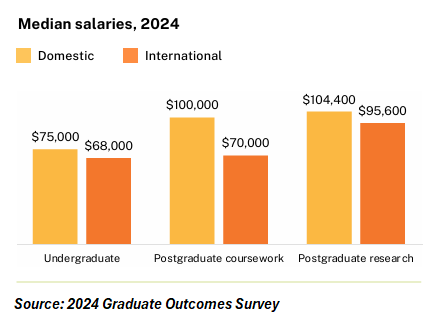
Therefore, the data clearly demonstrate that international graduates have poor labour market outcomes in Australia, with a large share working in poorly paid, low-skilled roles and many experiencing high rates of unemployment or underemployment.