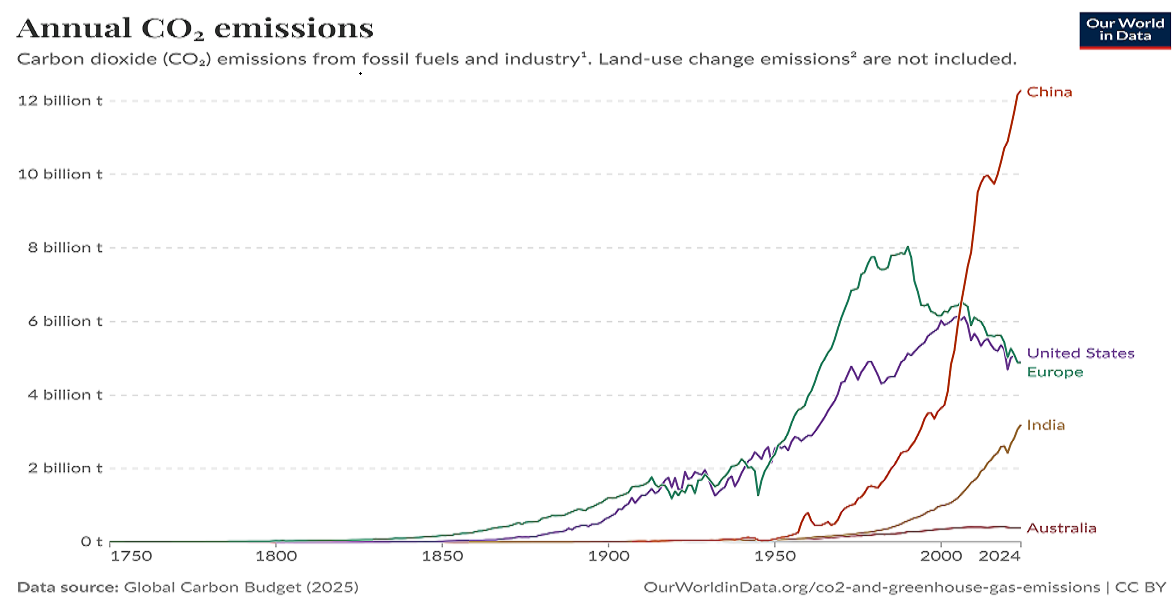
China is by far the world’s largest and major driver of carbon emissions:
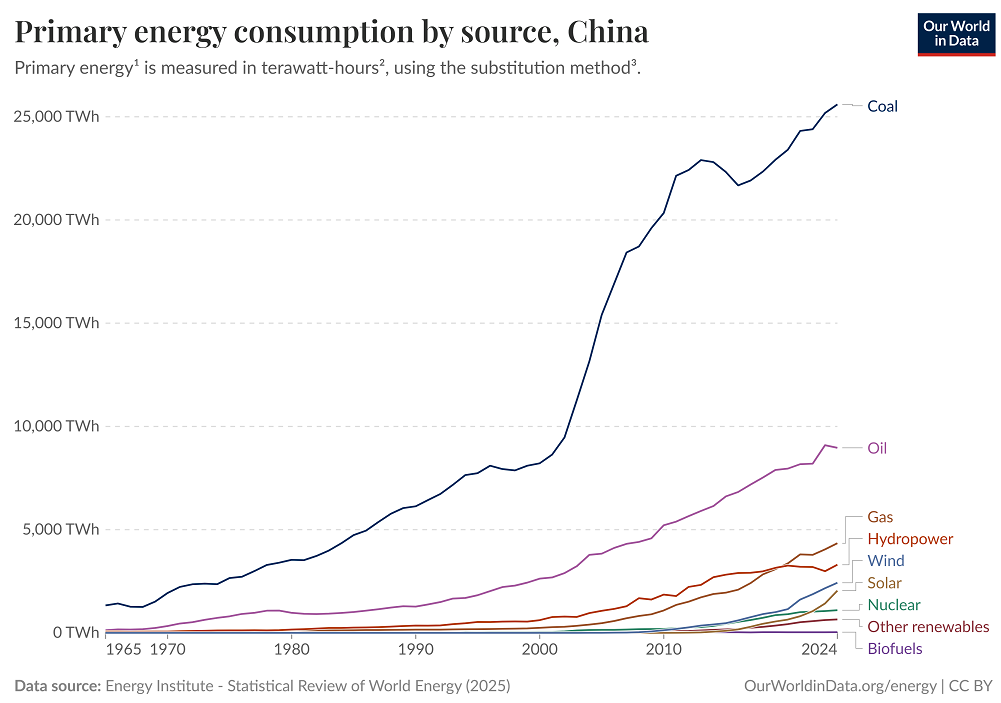
China’s growing emissions have been driven by its insatiable appetite for coal:
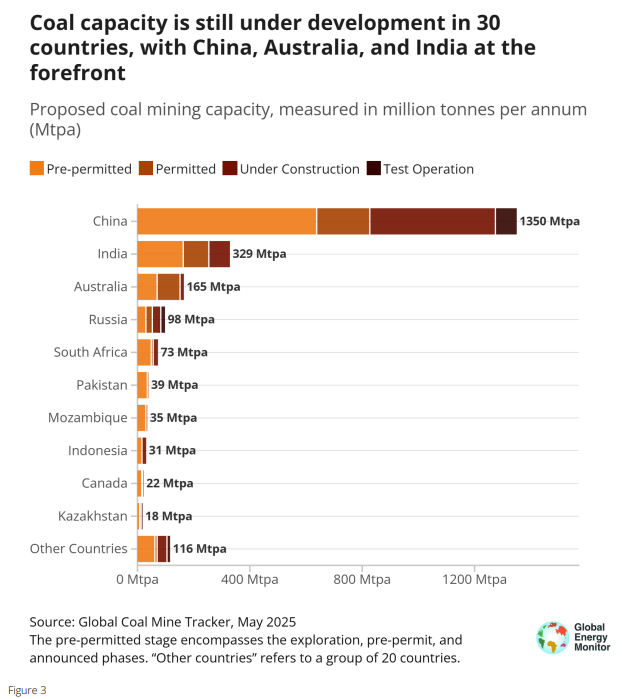
China has a significant number of new coal mines in development:
More than 50 large coal units—individual boiler and turbine sets with generating capacity of 1 gigawatt or more—were commissioned in China in 2025, up from fewer than 20 a year over the previous decade:
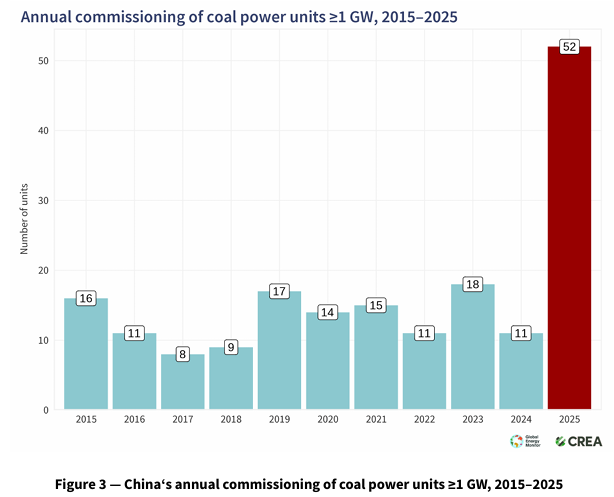
Overall, China brought 78 gigawatts of new coal power capacity online in 2025, a sharp uptick from previous years, according to the joint report by the Centre for Research on Energy and Clean Air and Global Energy Monitor.
The pipeline of Chinese coal power projects also remains strong:
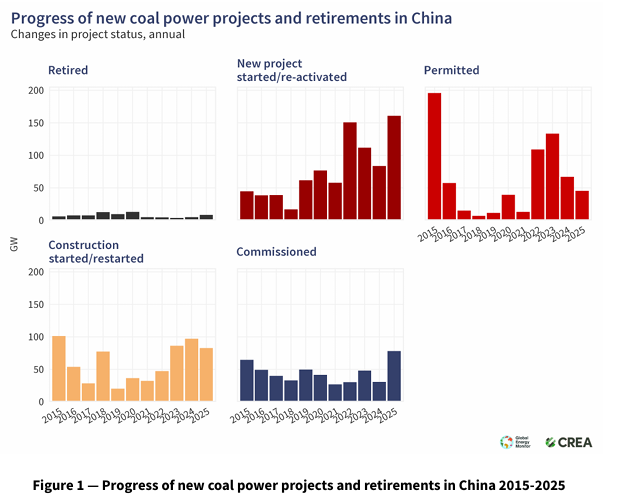
“The scale of the buildout is staggering”, said report co-author Christine Shearer of Global Energy Monitor. “In 2025 alone, China commissioned more coal power capacity than India did over the entire past decade”.
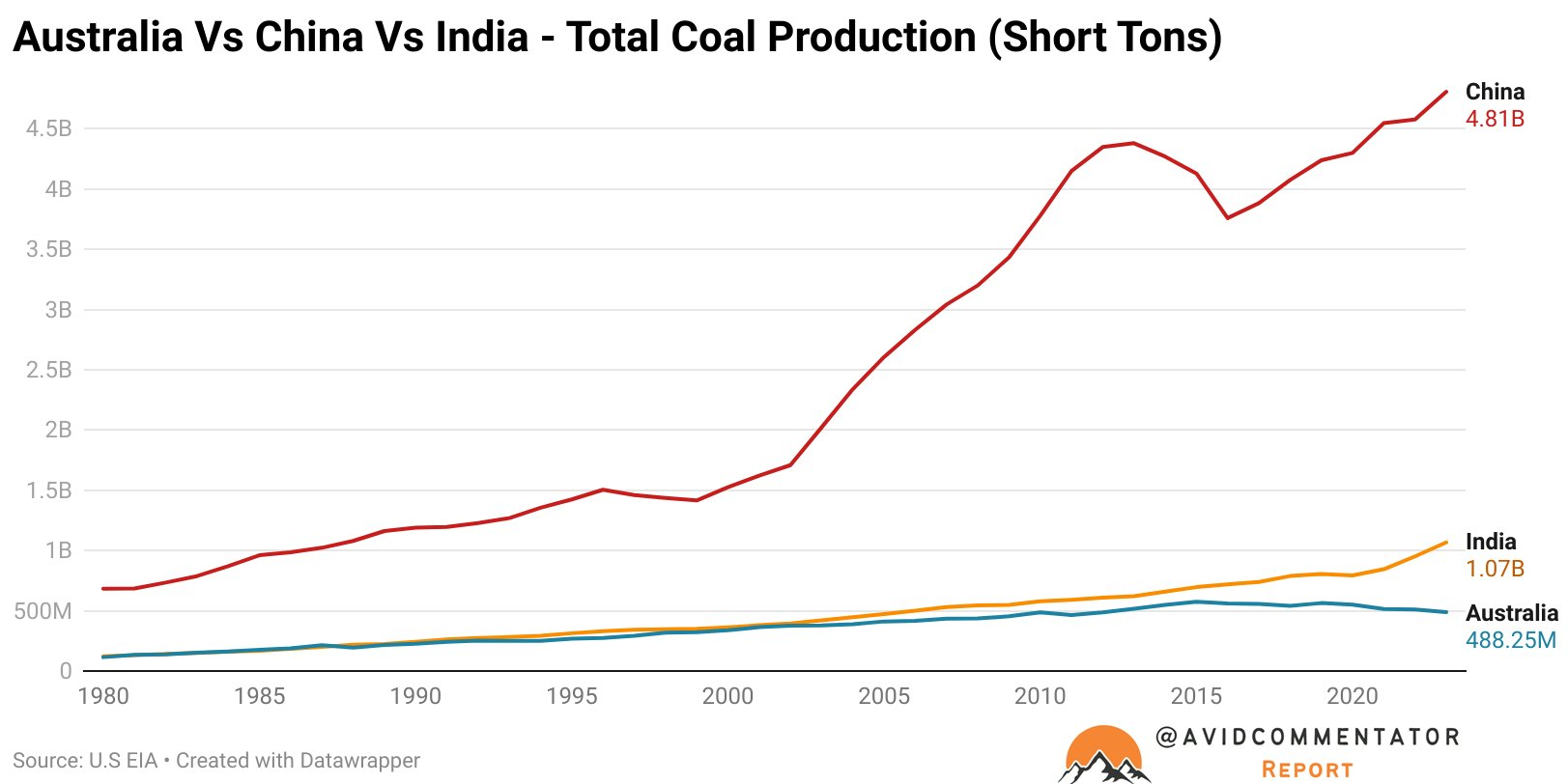
China produces around 10 times as much coal as Australia and is also the world’s largest importer, some of which comes from Australia.
China is aggressively pursuing coal gasification, especially coal‑to‑chemicals and coal‑to‑gas.
Coal‑to‑gas capacity under construction in China is four times what was built in the previous decade. If all planned projects proceed, capacity could double within five years.
China is also the only country in the world with large‑scale commercial CTL (coal‑to‑liquids) production. China’s CTL capacity is already over 10 million tonnes per year and expanding.
Now China is attempting to juke the stats to deceive the world on its emissions.
A new report from Carbon Brief explains how China has quietly changed the way it measures its core climate target — carbon intensity (CO₂ per unit of GDP) — dramatically lowering its reported emissions growth and creating a “Germany‑sized” gap in the numbers.
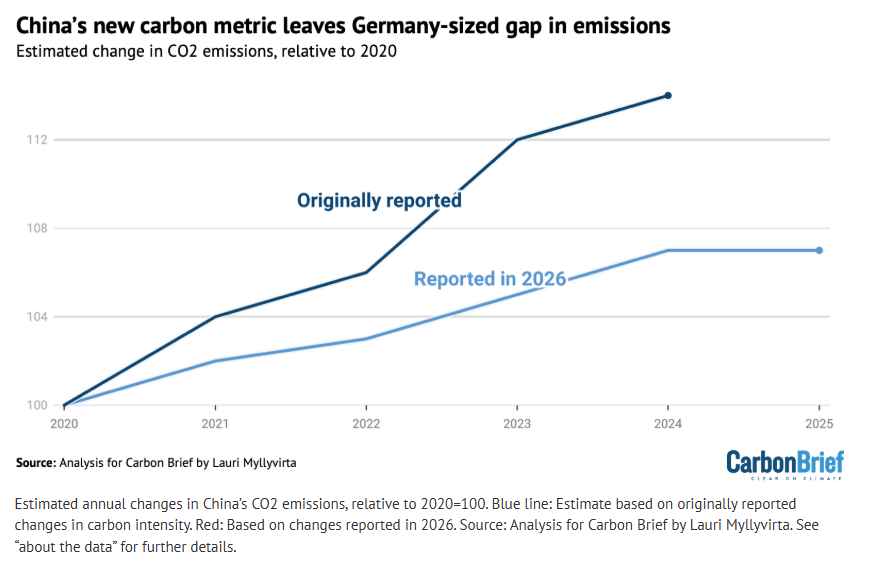
China’s government introduced a new, undisclosed definition of carbon intensity. Under the old method, China’s CO₂ emissions from 2020–2025 were estimated to have risen 14%. Under the new method, they appear to have risen only 7% — half as much.
This revision creates a gap of around 700 million tonnes of CO₂ per year, roughly equal to the annual emissions of Germany or South Korea.
Carbon Brief explains the implications of these changes as follows:
The change in the definition of carbon intensity has the effect of weakening China’s climate targets and introducing more uncertainty into tracking progress.
On the basis of China’s new numbers, it will require less effort to hit the 2030 target for a 65% reduction in carbon intensity on 2005 levels, as per China’s Paris pledge.
This target can now be met even if CO2 emissions go up between 2025 and 2030, whereas the previous metric would have required a reduction.
It will also require less effort to hit the 17% target in the 15th five-year plan.
The apparent gaps in the CO2 emissions numbers for 2025 could affect the delivery of China’s other key climate pledges, such as the commitment to peak CO2 emissions before 2030. They could also allow the chemical industry’s CO2 emissions to continue climbing rapidly, while still officially meeting the 2030 goals for CO2 intensity.
Moreover, the apparent gaps or inconsistencies in China’s new carbon accounting also mean that China would be able to officially meet its target to peak its CO2 emissions by 2030, even if its overall CO2 emissions do not actually reach a peak.
The apparent gaps could also affect the delivery of China’s newer target to cut its greenhouse gas emissions to 7-10% below peak levels by 2035 and beyond.
So basically, because the new metric shows faster improvement:
- China can meet its 2030 carbon‑intensity target even if emissions rise, not fall.
- China could officially “peak” emissions before 2030 even if real emissions keep increasing.
- The chemical industry could continue expanding its CO₂ output while China still meets its targets on paper.
The Bottom Line:
Anyone who thinks that China is decarbonising to achieve ‘net zero’ is either misinformed, delusional, or lying.
Meanwhile, Australia, which accounts for around 1% of the world’s carbon emissions, is busy deindustrialising through expensive energy and green/red tape.
Australia’s governments plan to shut down baseload coal generation in favour of weather-dependent solar and wind, backed by batteries, pumped hydro, and gas:
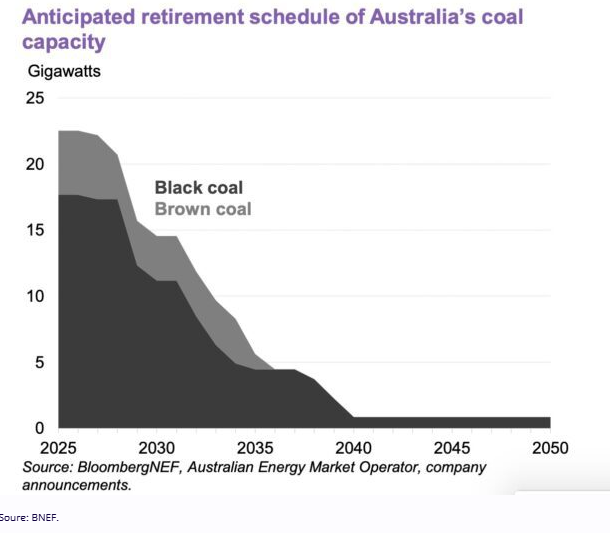
But it makes no sense for Australia to be the world’s largest coal exporter, some of which goes to China, but to refuse to burn it ourselves.
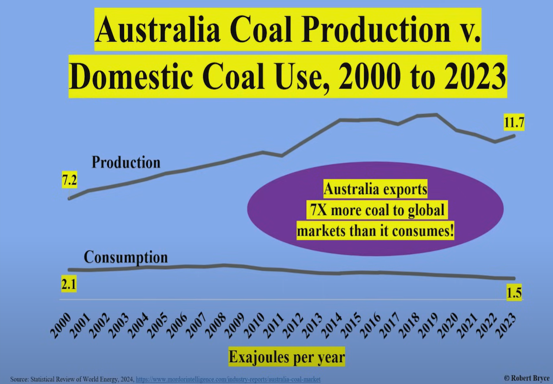
Australia should place energy affordability and security above ‘net zero’ concerns.
Global carbon emissions would be unchanged if Australia used more coal domestically rather than exporting it to China and other Asian nations.