Why, in a matter of only six months, has Alan Kohler performed a complete 180-degree flip on the housing market and the impact of historically high net overseas migration?
Let me explain.
In November 2025, Alan Kohler presented an excellent explainer video for the ABC, arguing that the surge in net overseas migration from the mid-2000s, driven in part by international students, is a key reason behind the nation’s housing shortage.
“That increase in student numbers contributed to a doubling of immigration in the mid-2000s, and that in turn contributed to an undersupply of housing for 15 years”, Kohler argued.
“The shortfall exacerbated during Covid, although it wasn’t offset by a surplus. So it’s still there and has now returned”.
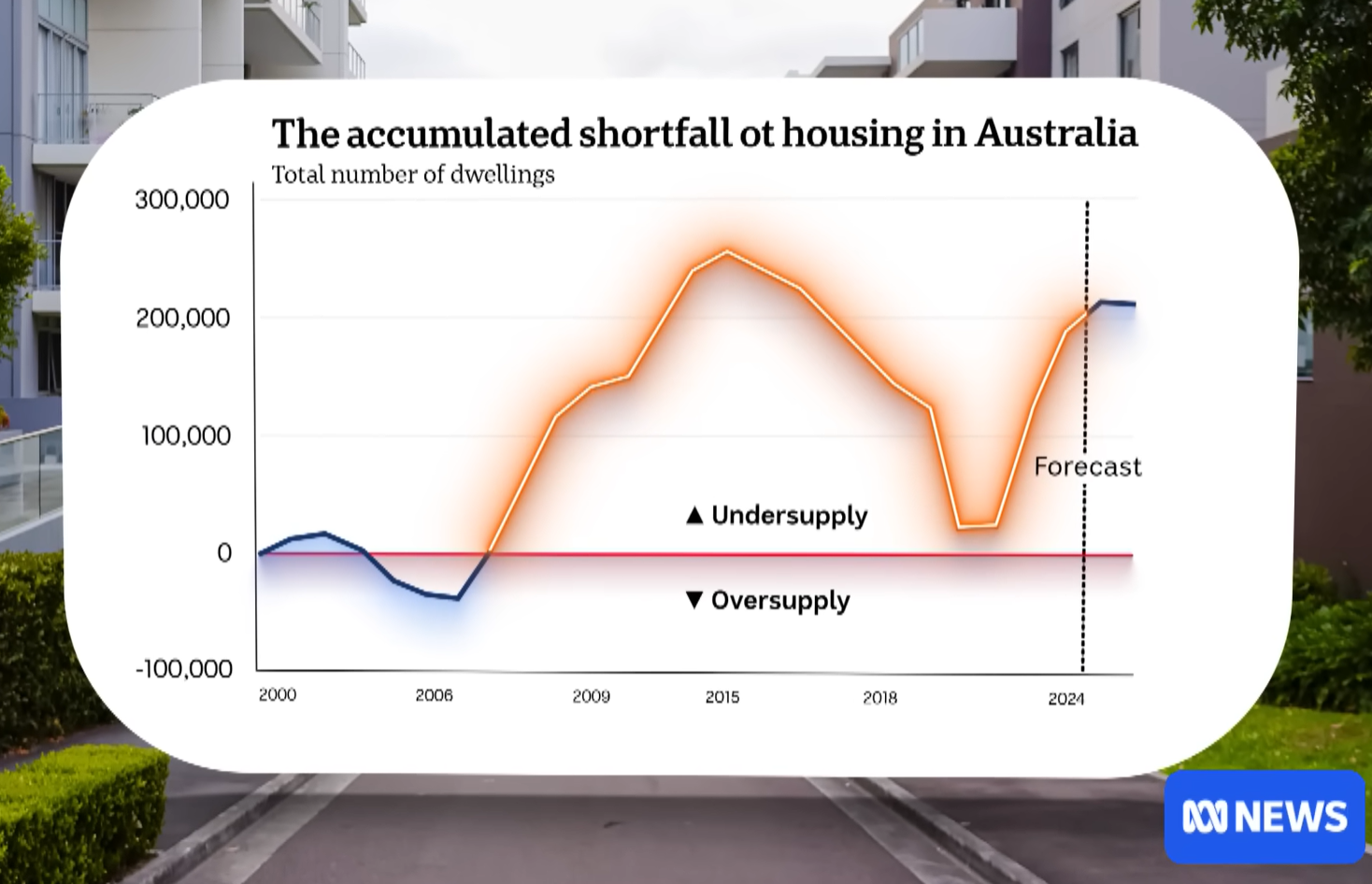
Kohler also said that, contrary to the 1950s and 1960s migration from Europe, “no tradies are coming from India and China to build the houses they need”.
It was an excellent summary by Kohler of the housing situation in Australia.
Kohler also wrote an article in August 2024 explaining how “Australia’s broken immigration system caused a housing crisis”:
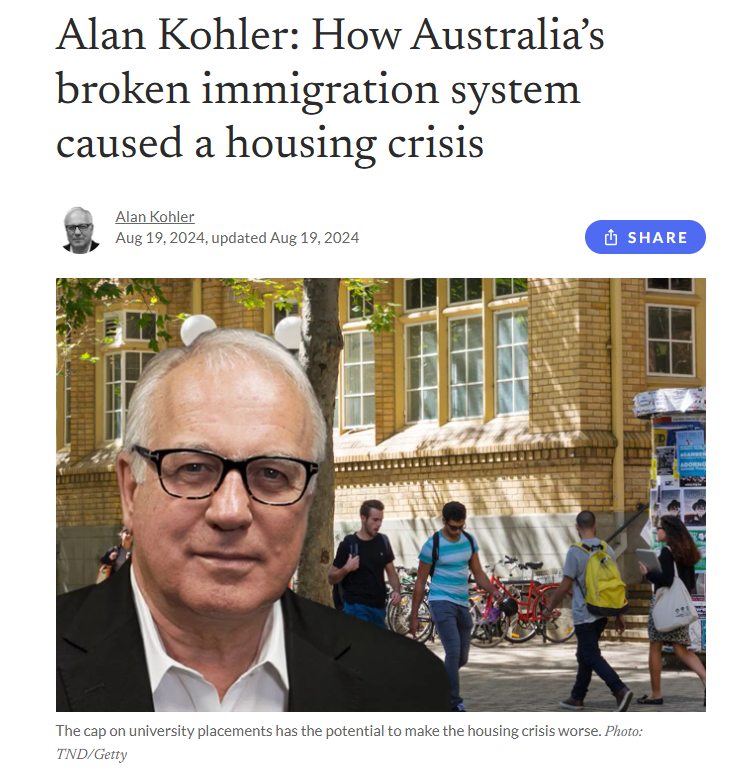
“One of the most important causes of Australia’s housing affordability crisis is excess immigration over many years”, Kohler wrote.
Kohler has since argued the opposite, now claiming that Australia has a housing surplus.
His change in opinion began two weeks ago when he stated the following on the ABC Insiders program [my emphasis].
“When I did a book on housing, I suggested that they link housing construction to immigration. But that was two years ago, right, and the net overseas migration two years ago was 536,000 and housing completions were 175,000. So there was actually a shortfall gap in that year”.
“But now net overseas migration is down to 300,000 in the most recent year and completions have stayed the same. So now on that calculation there’s a surplus of housing”.
Kohler went on to explain that the ratio of people per home is 2.4. Therefore, if Coalition leader Angus Taylor were to link immigration to housing supply, then he would have to increase immigration.
Kohler doubled down on this stance in his latest article for the ABC [my emphasis]:
In 2024-25, the latest year for which we have data from the Australian Bureau of Statistics, population growth was 419,300, made up of natural increase (112,600) and 304,700 net overseas migration (NOM) that includes the 185,000 target plus additional migrants drawn from those already in Australia for work or study, for example.
Using the average occupancy of 2.4 occupants per household, those extra people in 25-26 would need 174,708 places to live.
As it happens, dwelling completions in 2024-25 were almost the same as that — 174,792, or 84 more houses and flats than theoretically needed under Taylor’s plan…
In the second half of 2025, dwelling starts picked up to around 17,000 a month, or a bit more than 200,000 a year.
Meanwhile, natural increase is declining with the birth rate, and the Treasury is forecasting NOM this year will be 295,000, about 10,000 less than last year. The housing surplus this year is likely to be slightly more than last year.
There are fundamental problems with Kohler’s analysis.
First, it completely contradicts the chart he displayed above in November 2025, which showed a worsening housing shortage. Since that chart aired, NOM accelerated to 311,000 annually, which was only exceeded once in the nation’s history before the pandemic (i.e., in 2008):
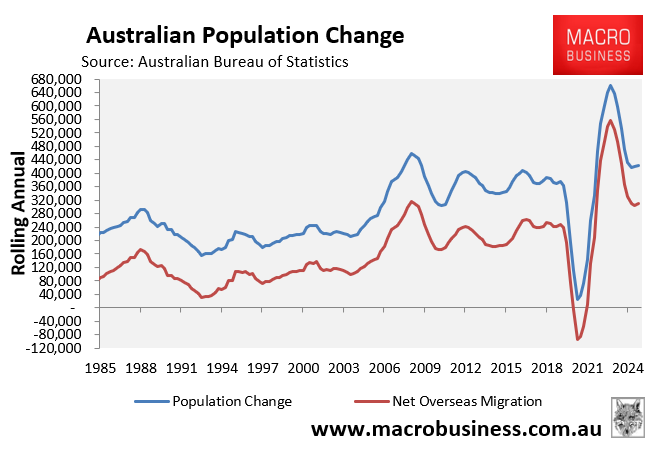
The same goes for overall population growth, which rose to 436,600 in the year to September 2025, which was also only exceeded once in the nation’s history before the pandemic.
At the same time, actual dwelling completions fell to only 172,700 in 2025:
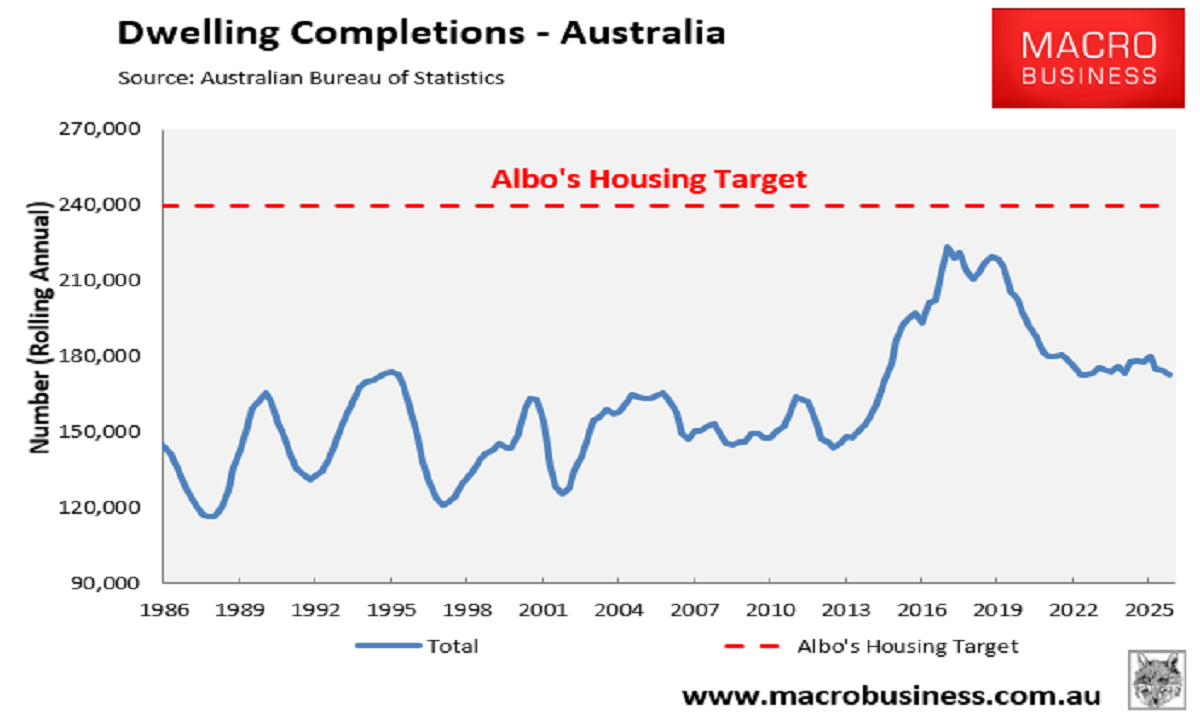
Thus, with historically strong population growth and weak housing construction, how can Kohler seriously claim that there’s a “housing surplus”, especially when only six months ago he claimed the opposite when population growth was softer, and actual dwelling completions were stronger?
Even using Kohler’s flawed 2.4 ratio of people per dwelling, 436,600 population growth in the most recent year would have required 181,900 dwellings to be completed, which Australia missed by around 9,000.
The number of homes completed also does not account for demolitions, such as when a single-family home is replaced with two townhouses.
According to the latest State of the Housing System report from the National Housing Supply and Affordability Council, 21,000 homes were demolished in 2024-25, reducing net additions to housing supply to only 153,000, a 12% decline.
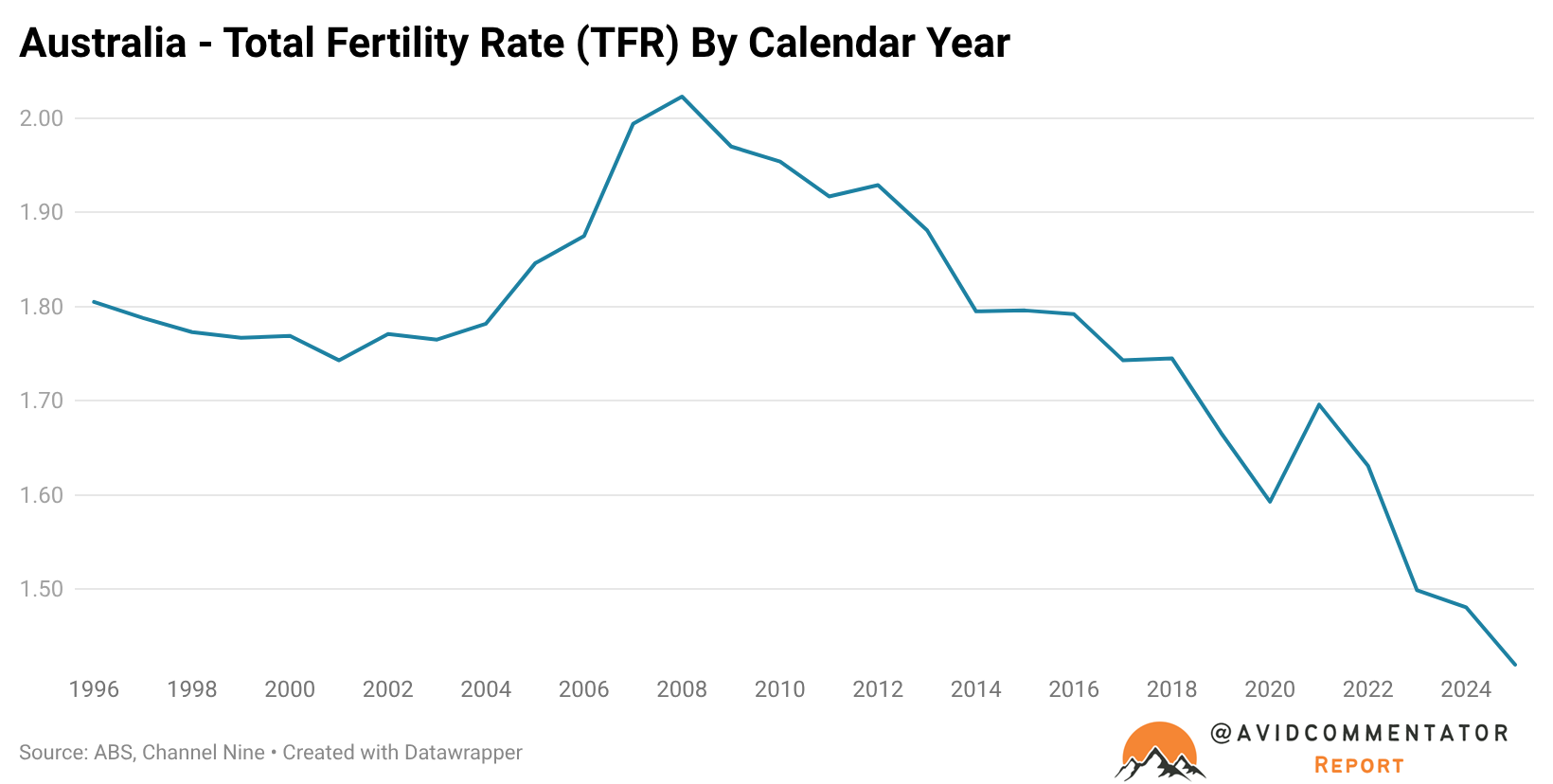
Kohler’s 2.4 ratio of people per dwelling also doesn’t account for the fact that with an ageing population and shrinking household sizes (due to fewer children), we need more homes for a given population size, regardless of NOM.
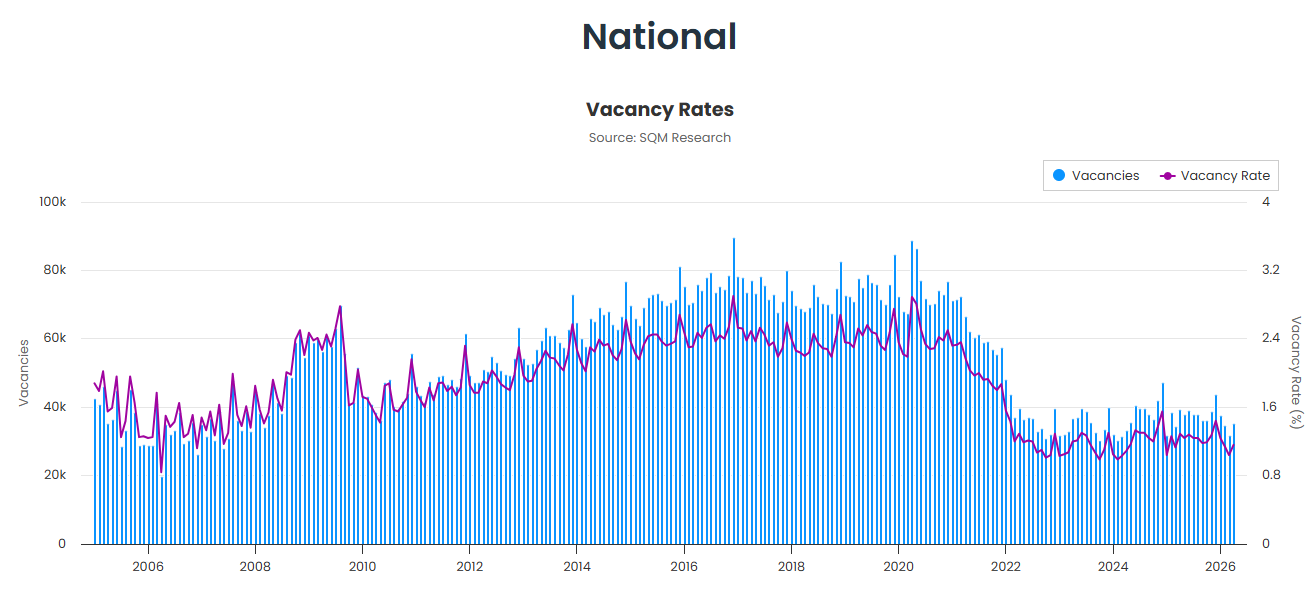
Ultimately, one only needs to look at the collapse in the rental vacancy rate to see that supply hasn’t kept pace with demand:
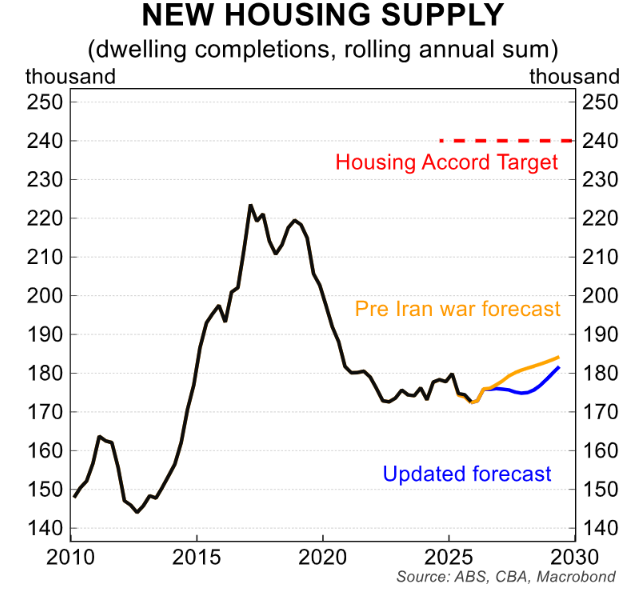
With Australian dwelling construction forecast by CBA to remain in the doldrums due to cost inflation from the energy shock and higher interest rates:
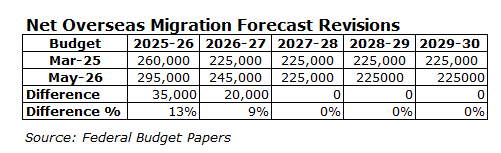
And NOM forecast to remain historically high:
Australia’s housing shortage and rental crisis will inevitably worsen.
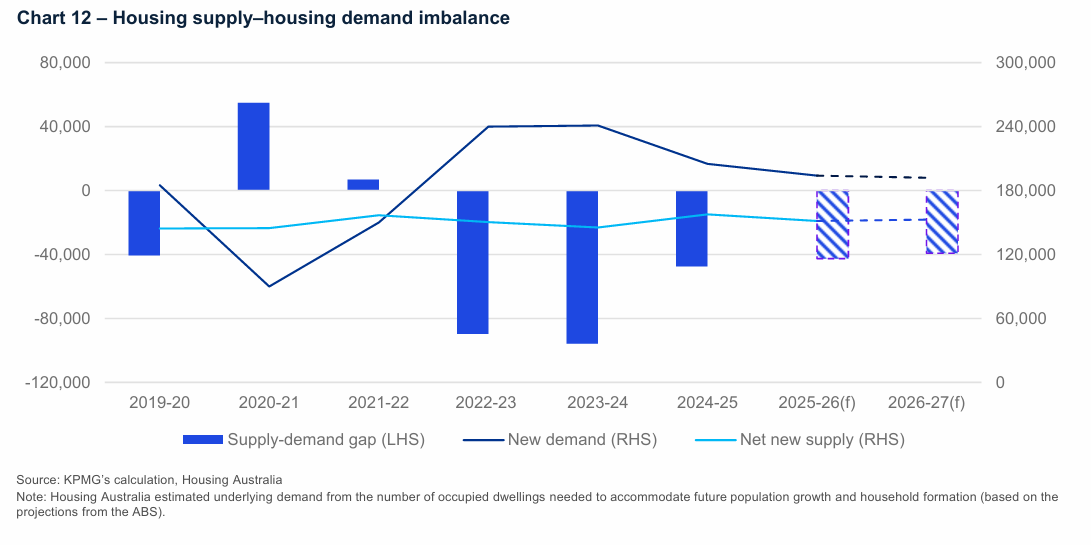
Indeed, a worsening shortage is exactly what KPMG forecast in its latest annual housing market report:
It is also why rental growth has accelerated.
Again, why has Alan Kohler changed his tune from six months ago?
Hilariously, Kohler contradicts himself later in the same ABC article, admitting that excessive immigration has created a housing shortage:
It’s true that an important reason Australia has a housing affordability crisis is that between 2005 and 2015, and then again between 2022 and 2025, a big increase in migration was allowed to happen without reference to the number of houses being built.
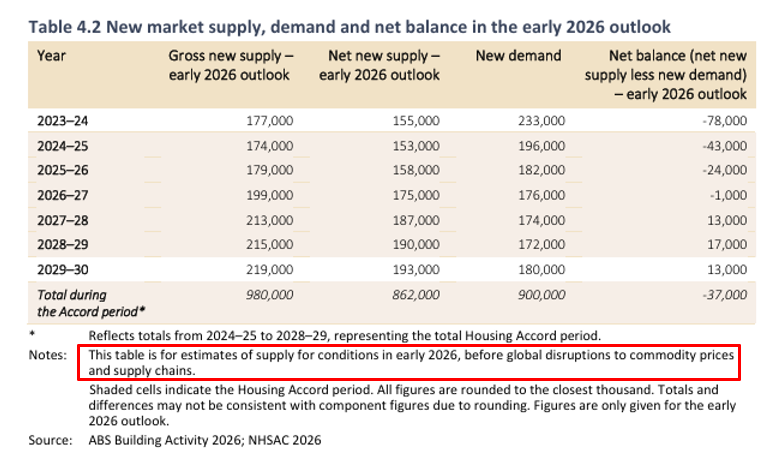
The shortfall that developed still largely exists — the industry has not cleared it yet, and the National Housing Supply and Affordability Council (NHSAC) says that it won’t catch up for a while.
It is forecasting demand in the five years from July 2024 to 2029 of 900,000 and net new dwellings — that is, after demolitions — of 862,000, a further (small) shortfall.
So Alan, why did you claim earlier that the “housing surplus this year is likely to be slightly more than last year”? Does Australia have a shortage or not? Why are you playing both sides?
It is important to note that NHSAC’s latest forecasts are laughable, as they ignore the impacts of the war in the Middle East [see red box below]:
Yet, a conga line of developers have warned that soaring input costs—ranging from PVC pipe, to cement and timber—will increase the cost of homebuilding and curtail new supply.
NHSAC’s baseline forecasts, quoted above by Kohler, completely ignore the new reality facing the construction sector. Fewer homes are likely to be built, not more, as forecast by CBA above.
NHSAC does mention later in its report that the war in the Middle East presents a significant downside risk to its forecast and could lower supply by 33,000 homes:
The prolonged [Middle-east war] scenario assumes a peak increase in construction costs facing the sector of 10% cent in mid-2026, returning to previous trends over 6 years. The assumed construction cost shocks are relative to the early 2026 outlook and are informed by industry reporting and a range of data sources…
In the more prolonged scenario, gross new housing supply is estimated to be 33,000 dwellings lower over the Housing Accord period…
Given the war in the Middle East is likely to be prolonged, why didn’t NHSAC consider the impact of the war in its baseline forecasts?
NHSAC also underestimated population growth by using MYEFO’s NOM forecasts, which were revised up by 55,000 in the latest budget:
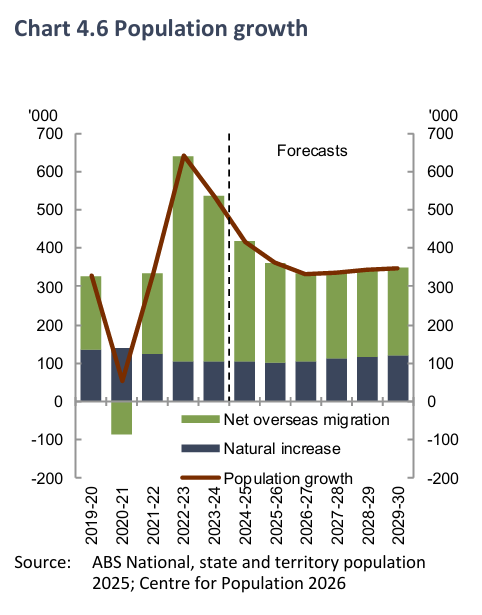
Thus, housing demand will be higher in the period ahead than NHSAC has forecast, and new supply will very likely be lower.
Overall, NHSAC’s 2026 State of the Housing Supply is misleading propaganda that doesn’t match reality on the outlook for construction or immigration.
Yet, Kohler has presented it without criticism while ignoring CBA’s latest forecasts of slower construction.