Tim Toohey from Yarra Capital recently warned that if AI is “deployed at scale in Australia over the next two years”, then the nation’s unemployment rate could rise to over 6%, up from 4.3% currently.
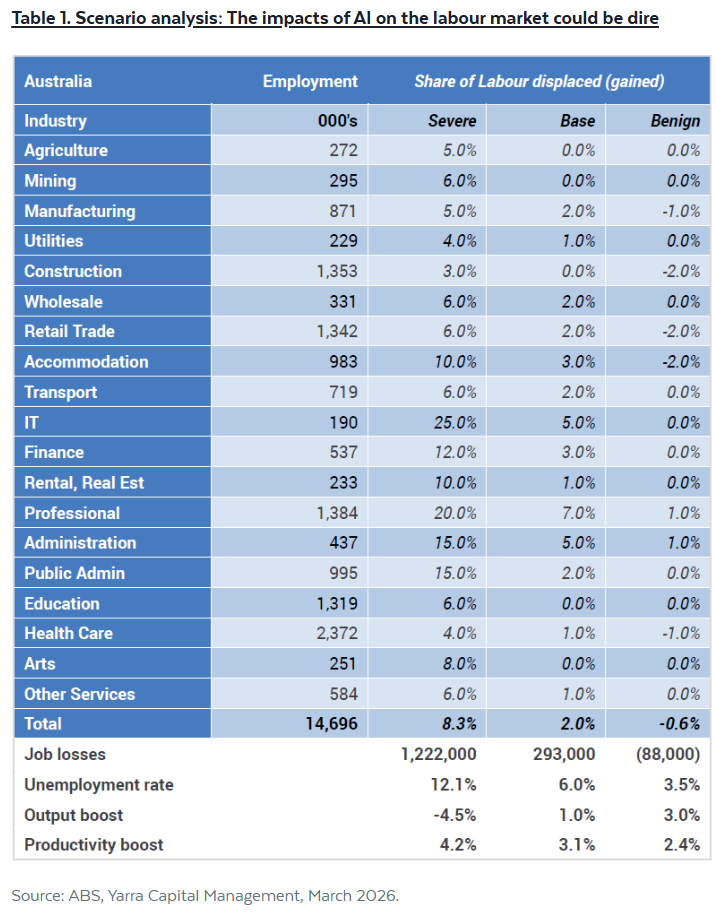
The latest Mercer survey of Australian senior executives, human resources personnel, and employees also revealed that 100% of HR managers believed their company would reduce headcount due to AI within two years, with 60% believing that one in five jobs would be lost to AI.
The impact of AI is already causing the most significant pain in the graduate employment market, according to Nina Hendy, a business and finance journalist at The Age.
Hendy writes that entry-level and graduate roles now comprise only 11% of all vacancies—the lowest in a decade, according to new research from Anglicare.
Traditional youth‑absorbing sectors like retail and hospitality are shrinking due to self‑service checkouts, automated inventory systems, and dynamic scheduling, which reduce casual shifts.
Traditional graduate programs are being overwhelmed with up to 10,000 applicants for 20 roles.
Meanwhile, AI‑driven job losses are accelerating, with major firms like WiseTech, Amazon, Meta, and Atlassian cutting thousands of roles as AI replaces routine tasks. And experts warn that this is only the beginning.
AI adoption will be strongest for tasks that are predictable, text-heavy, and standardised.
Entry‑level employees are now expected to contribute analysis, judgment, communication, and technical fluency from day one. However, AI is likely to replace the very roles that historically taught these skills.
“If too much of that early-stage work disappears, we risk making it harder for people to get a start”, Kris Grant, chief executive of recruitment and training firm ASPL Group, told The Age.
“The biggest risk is not AI alone. It is that organisations expect entry-level candidates to arrive fully formed, while removing the very roles that used to help them build those skills”.
To add insult to injury, young Australian graduates are also competing for jobs against large numbers of international students and graduates.
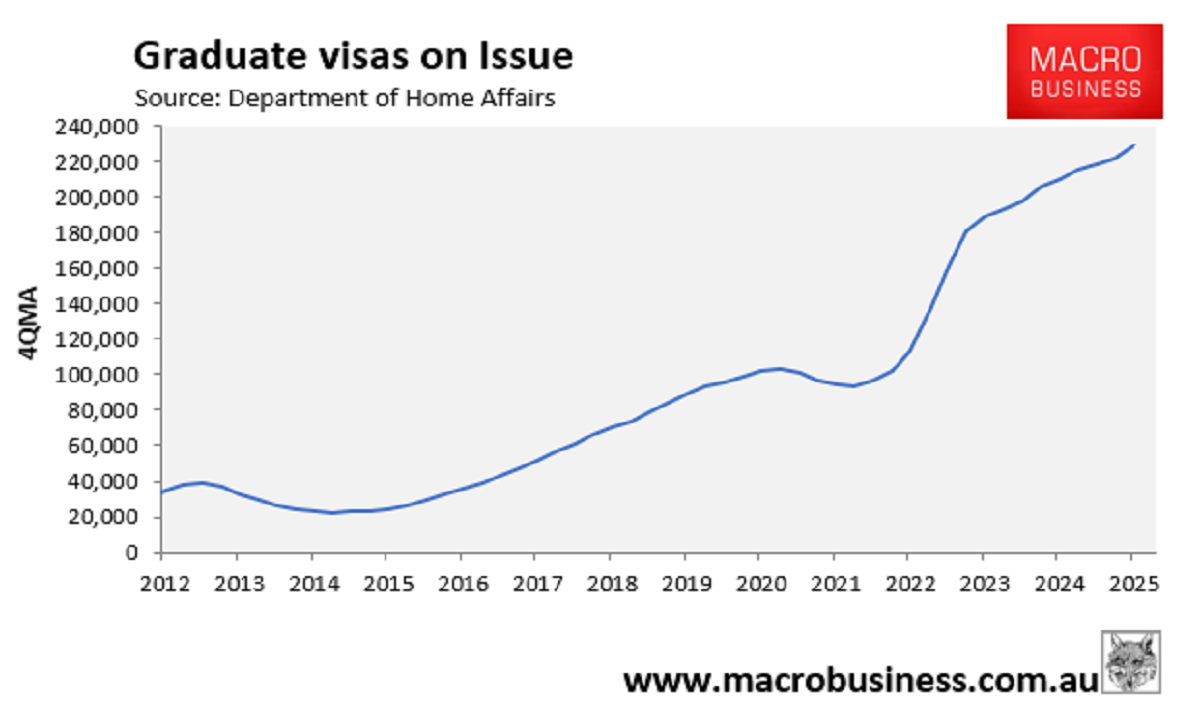
At the end of 2025, there were nearly 230,000 graduate visas on issue in rolling annual terms, almost 10 times more than a decade prior:
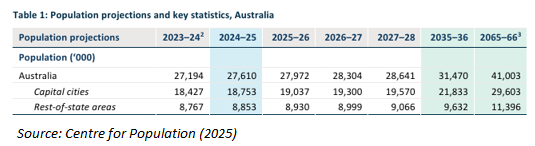
Australia’s mass migration model is projected to continue indefinitely. The Centre for Population projects that Australia will grow by 13.4 million people over the 41 years to 2065-66, equivalent to adding another Sydney, Melbourne, and Perth:
Yet, importing hundreds of thousands of people each year into a job market ravaged by AI does not make policy sense.
Goldman Sachs analyst Joseph Briggs contends that artificial intelligence can potentially automate tasks that account for 25% of all work hours in the US and 6% to 7% of all jobs.
Billionaire investor Howard Marks, of Oaktree Capital, added that “AI is able to change the world at a speed that approaches instantaneous, outpacing the ability of most observers to anticipate or even comprehend”.
“AI can rapidly put people out of work for whom it will take years to find and be trained for new careers. It’s hard to think the speed of change under AI won’t vastly outstrip society’s ability to adjust”, he said.
Recall BlackRock CEO Larry Fink’s testimony at Davos when he stated that nations with low or negative population growth will adapt better to AI:
“We always used to think shrinking population is a cause for negative growth. But in my conversations with the leadership of these large developed countries that have xenophobic immigration policies that don’t allow anybody to come in, these countries will rapidly develop robotics and tech and AI and technology”.
“If the promise of all that transforms productivity, which most of us think it will, we’ll be able to elevate the standard of living of countries and standard of living of individuals even with shrinking populations”.
“And so the paradigm of negative population growth is going to be changing and the social problems that one will have in substituting humans for machines are going to be far easier in those countries that have declining populations”.
With AI set to replace a significant share of jobs, why is Australia continuing to run a high immigration program?
In the era of AI, mass migration is surely a recipe for higher unemployment and civil unrest. Australia’s youth will bear the brunt of this situation.