This week, the Australian Bureau of Statistics (ABS) released data on net permanent & long-term (NPLT) arrivals, which remained at historically high levels in February 2026.
In the year to February, 479,000 NPLT arrivals landed in Australia, a whisker below the all-time high level of 498,000 recorded two years prior in February 2024.
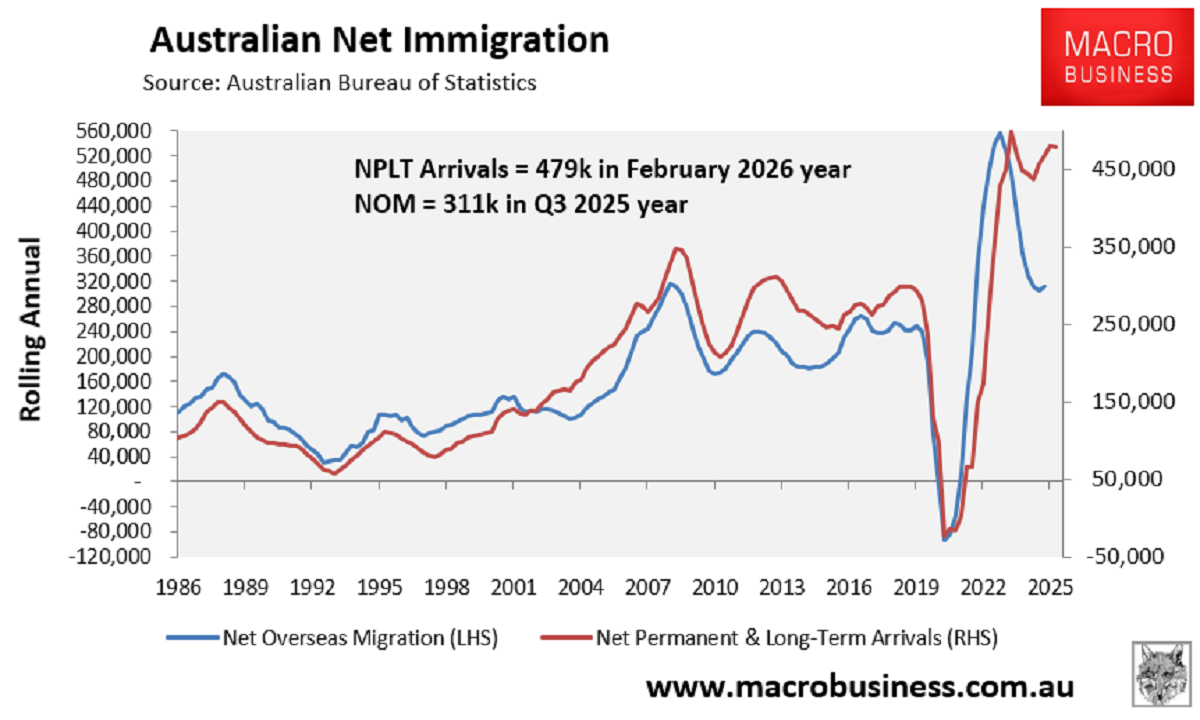
The latest official quarterly net overseas migration (NOM) data from the ABS also rose to 311,000 in the year to September 2025 – a level that would rank as the second highest in Australia’s history before the Covid-19 pandemic.
The high number of overseas arrivals requiring housing has placed immense pressure on the nation’s rental market.
According to the latest rental vacancy data from SQM Research, the nation’s vacancy rate collapsed to only 1% in March 2026, tracking at less than half the pre-pandemic level:
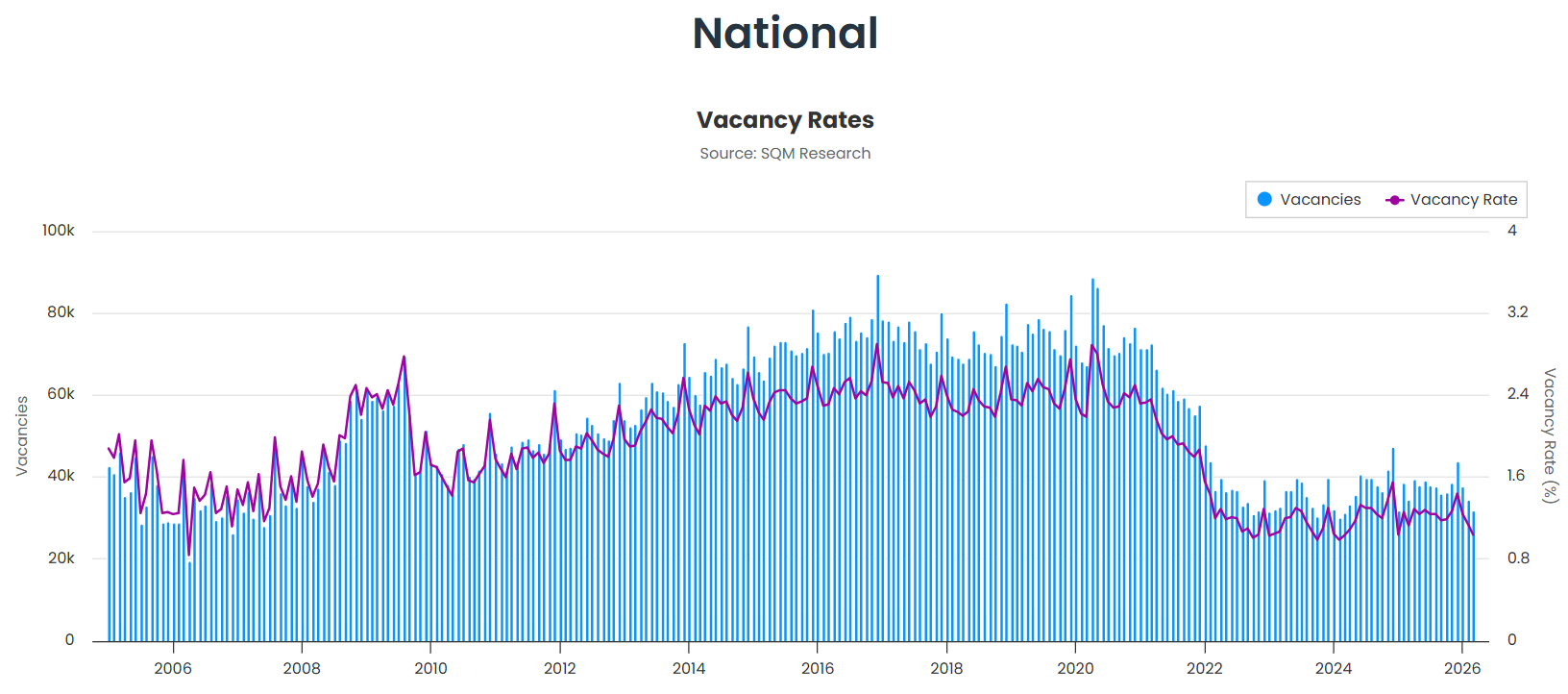
Source: SQM Research
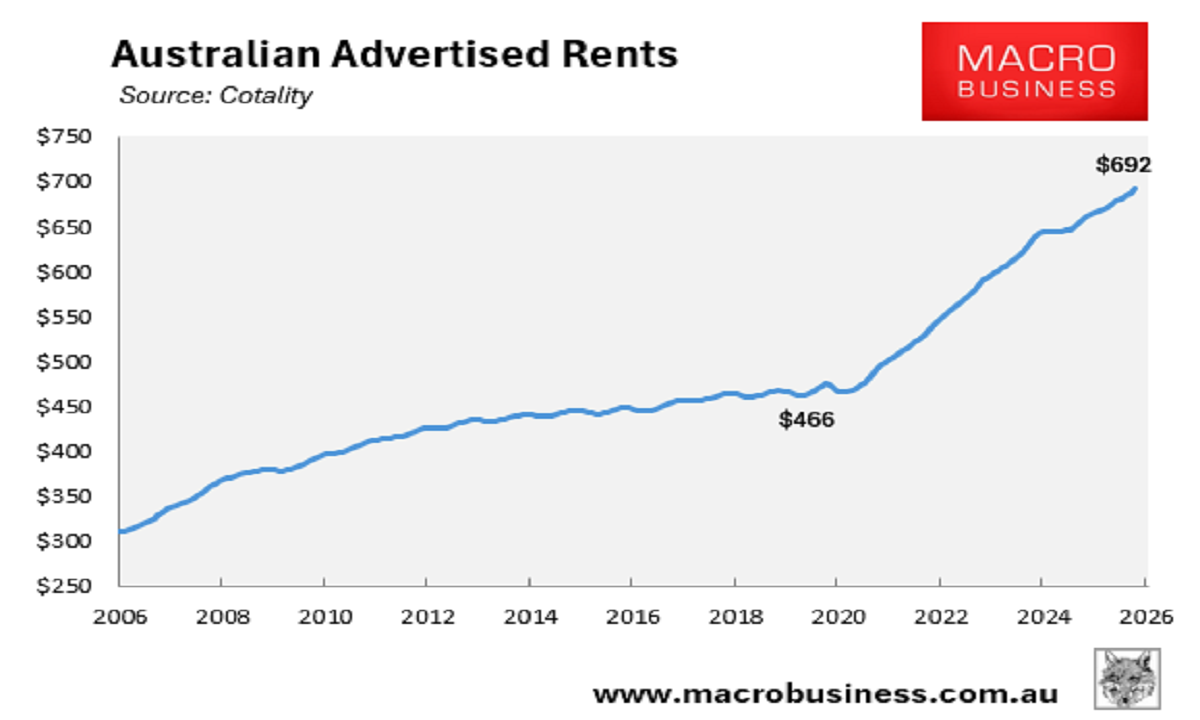
Cotality’s advertised rent series has risen by 48% nationally since the end of 2019, adding around $11,700 to the annual cost of renting the median home.
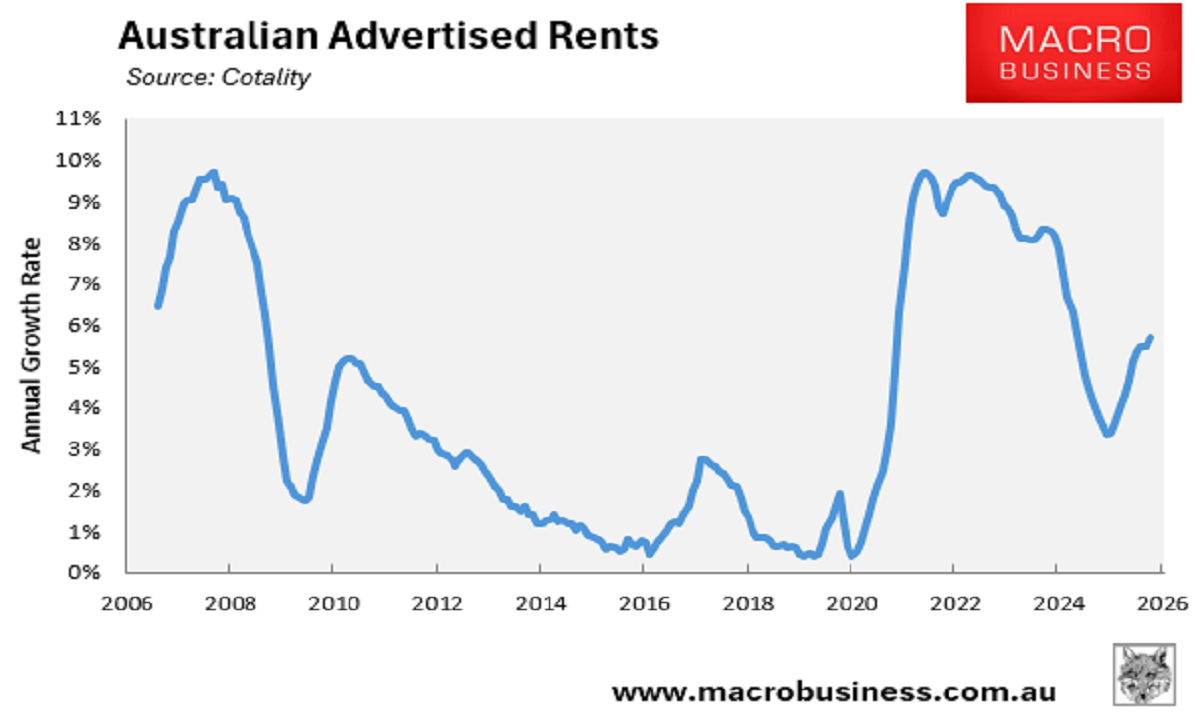
Cotality has also recorded a resurgence of rental growth, with advertised rents nationally growing by 5.7% in the year to March 2026 – well above wage growth of just over 3%:
SQM Research founder Louis Christopher was blunt in his assessment about the prospects for Australian renters, noting the following about the collapse in vacancy rates:
“Without a significant increase in new housing supply and/or a stabilisation of population growth rates, it is likely that rental pressures will remain elevated throughout 2026. These accelerated rates of rental increases will no doubt feed through to the CPI at some point this year”.
Sadly, the housing supply situation in Australia is likely to worsen in the period ahead amid the global energy shock.
Last week, developers across Australia warned that the cost of building homes will inevitably increase due to a rise in materials costs, including fuel (diesel), pipes, cement, and masonry products.
Nigel Satterley, CEO of Australia’s second-largest residential land developer, Satterly Property Group, warned that the war could add another $50,000 to the cost of building new homes.
Privately owned property development and construction company Deicorp warned that “feasible projects are now marginal, and marginal projects are now unfeasible”.
At the same time as housing construction is likely to fall, Treasurer Jim Chalmers last month admitted that NOM will be higher than the government had anticipated.
The upcoming federal budget will reportedly forecast NOM of more than 300,000 this financial year, up from 260,000 in last year’s budget.
NOM in the forward budget estimates will also likely be revised higher.
The combination of declining housing construction and historically high immigration levels poses a nightmare situation for Australian tenants, who are facing an increasingly competitive rental market.
Canada shows how to fix the rental crisis:
Canadian tenants, who suffered from a similar immigration and rental surge after the pandemic, are facing the polar opposite circumstances, courtesy of the centre-left Liberal government’s decision in 2024 to slash immigration to stabilise population growth to relieve pressure on housing and infrastructure and rebalance the economy towards sustainable growth.
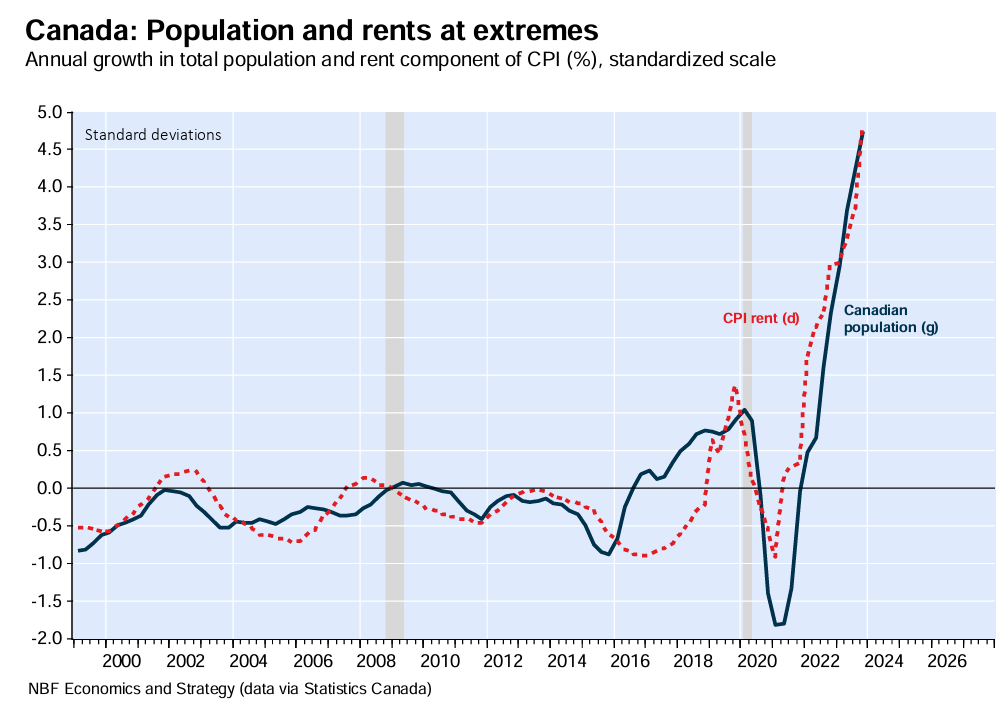
In early 2024, Canada’s rental and population growth were extreme
Canada’s immigration reforms included reducing annual permanent-resident targets by around 25% by 2027, restricting international-student and temporary-worker admissions, and tightening asylum and border rules.
Canada set specific targets for non-permanent residents (NPRs), including international students (the most substantial reductions) and temporary foreign workers.
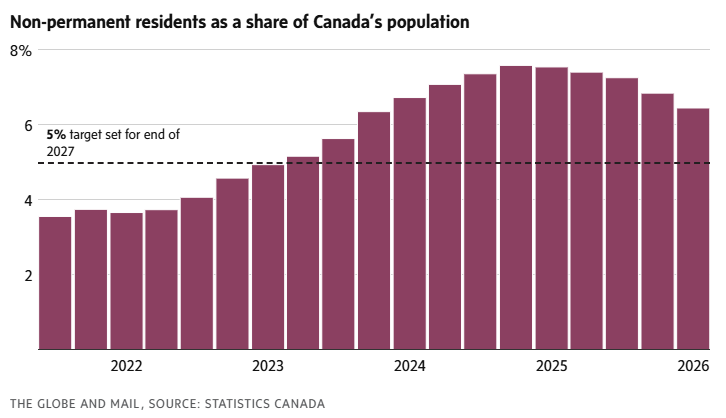
By the end of 2027, NPRs are projected to comprise 5% of Canada’s population, down from 7.6% at its peak.
Canada’s immigration reforms have proven effective.
According to the latest data from StatsCan, published in the Globe & Mail, Canada recorded a population decline of 102,000 people in 2025, or 0.25%. This represented the nation’s first annual decline in population in records dating back to the 1940s:
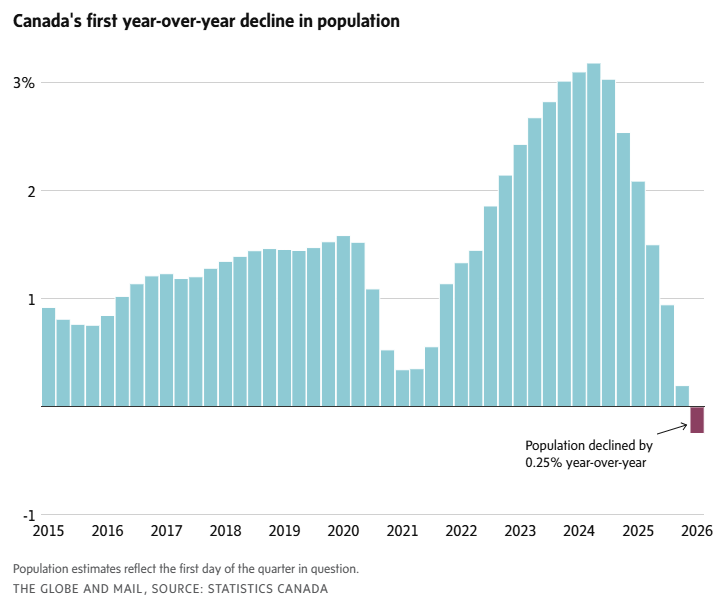
Canada’s population decline was driven by an exodus of NPRs, with the number falling by 171,300 last year.
As a result, the total population of NPRs fell to 2.67 million, or 6.4% of the total population, down from a peak of 7.6% of the population in 2024:
StatsCan also reported a sharp year-over-year decline of nearly 20% in the number of permanent resident admissions to Canada, in line with the targets established by the federal government.
The impact of Canada’s immigration cuts is most evident in the nation’s rental market.
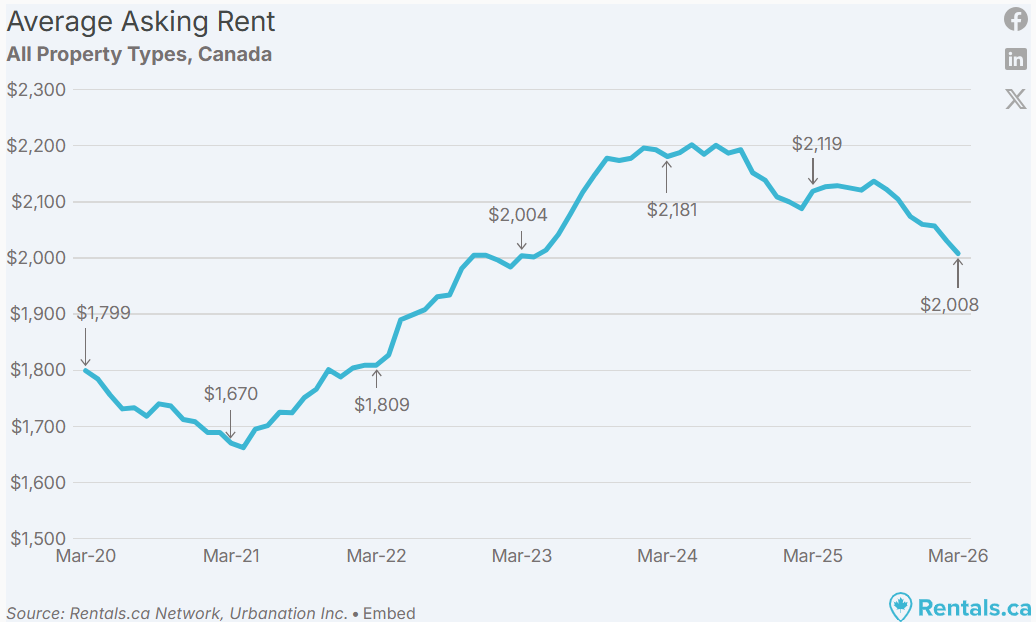
Data released this week by Rentals.ca showed that average asking rents in Canada fell to a 35-month low of $2,008 in March, following 18 consecutive months of declines.
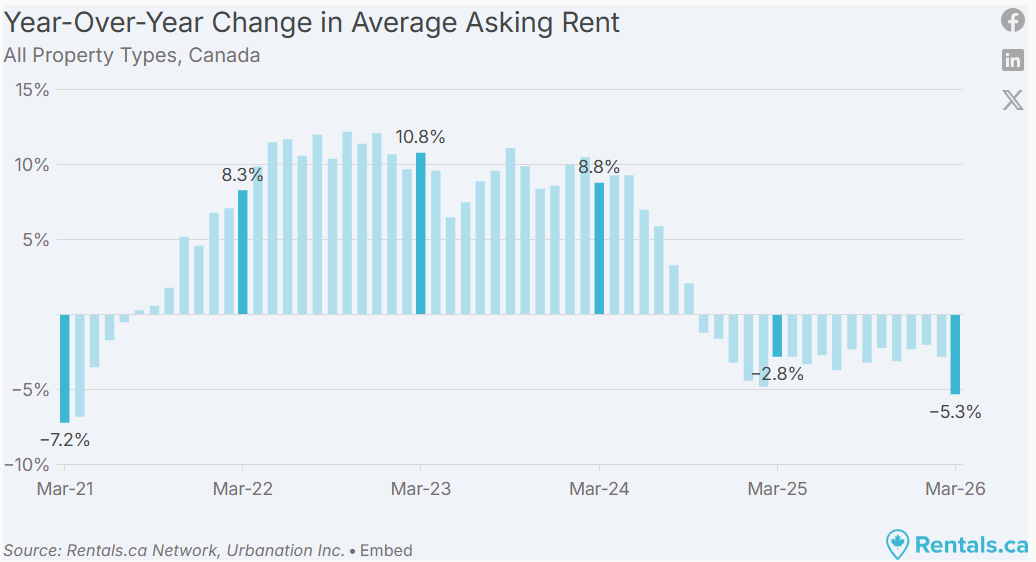
Canadian rents have fallen by $194 (8.8%) from their May 2024 peak. As a result, Canadian tenants are now saving $2,328 annually on rental costs.
Policy lessons for Australia:
The data above show that Canada’s sharp immigration cuts are rapidly solving the nation’s rental crisis, saving tenants thousands of dollars each year in rent.
Australia’s federal government should emulate Canada and ease its rental crisis by sharply cutting immigration.
Doing so would rebalance demand with supply, lifting the rental vacancy rate and placing downward pressure on rents.
I discussed this issue with Bill Woods at Radio 2GB: