University students have pushed back against moves to require them to attend in person to combat AI cheating, citing high transport costs.
National Union of Students President Felix Hughes says students are “skipping meals” and “burning out” just to stay enrolled.
He claims that some students are being forced to choose between getting to class and paying for essentials.
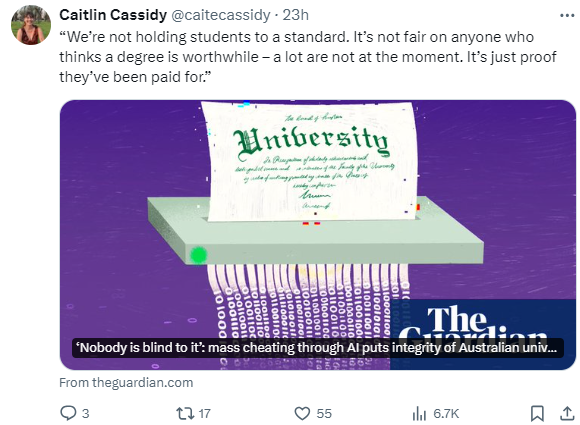
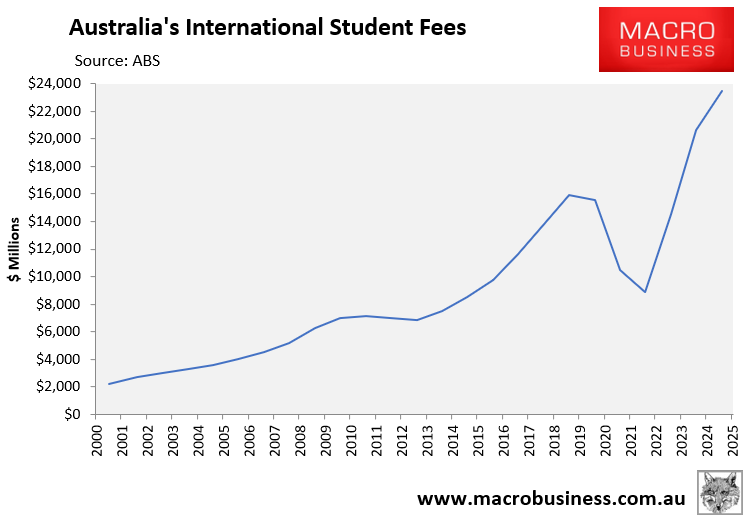
The pushback by students follows last week’s report on how Australia’s universities are experiencing a system‑wide breakdown in academic integrity, driven by widespread AI‑assisted cheating, weak enforcement, and financial dependence on international student fees.
This followed earlier reporting by The Guardian, which showed “mass cheating” led by international students and claimed that academics were discouraged from failing poor‑performing students because it threatened revenue.
According to research by Dr Jonathan Albright (UWA), all 38 public universities have dropped or heavily caveated AI‑detection tools. Even the Group of Eight universities refuse to rely on AI detection tools as evidence of misconduct.
UQ warned that detection tools “disproportionally flag certain cohorts”—widely interpreted as international students—who generate billions in fee revenue.
Universities shifted heavily to online exams during COVID because they are much cheaper to administer, even though they are much easier to cheat on.
The obvious solution is to mandate in-person exams and to vet international students more rigorously before granting them student visas.
However, universities avoid such measures because of their potential to increase costs and reduce fee revenue.
Dr Michael Hitchens (Macquarie University) claimed that university leadership explicitly avoids measures that increase costs, such as in‑person exams or attendance requirements, because they require rooms, supervisors, printing, and handling absences and supplementary exams:
“If you want to run an in-person exam, you have to allocate the room, hire the supervisors, print the exams, check those printouts, deal with the students who can’t attend that day, organise the supplementary exams – and that all costs money”.
“And those people calling for old-school, closed-book types of assessment are treated like dinosaurs. For the same reasons, unis don’t like to mandate student attendance anymore – because it costs money to process non-attendance”.
“COVID was a lifesaver for higher education because it forced learning online, where it’s far cheaper to run.”
As a result, Australia’s universities have devolved into revenue‑driven degree mills with declining academic standards and eroding credibility.
Ultimately, a return to in-class teaching and exams is essential to restoring integrity to the higher education system and ensuring that degrees retain their value.
Old-fashioned, paper-based, in-person exams are the only way to ensure that students do not cheat and understand the coursework.