Due to its immense size, isolation, and industry composition (i.e., heavy mining and agriculture), Australia is literally one of the most diesel-dependent economies in the world.
The following chart from CBA shows that Australia consumed 7.7 barrels of diesel per person in 2024, the highest out of the nations surveyed:
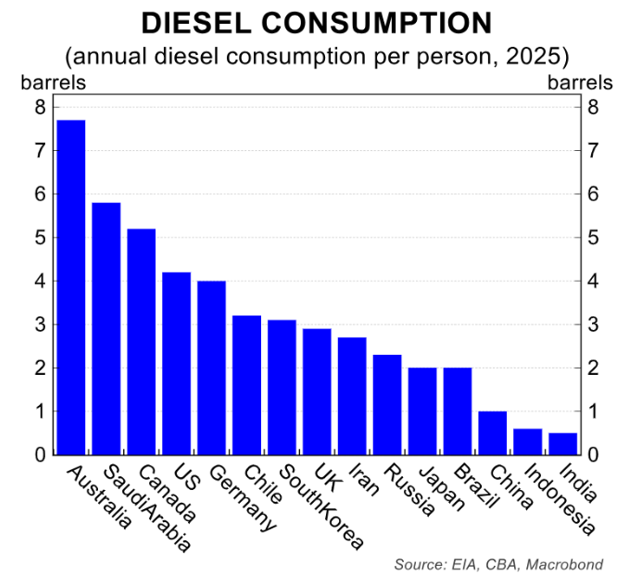
“Australia uses more diesel per capita than most major economies“, CBA wrote in a recent report.
“Diesel consumption was 7.67 barrels per capita in 2024, according to the Energy Information Administration (EIA). That’s about 80% above levels in the United States at 4.01 barrels per person and eight times more than China at just 0.96 barrel per day”.
“Australia’s diesel-dependence is in part due to its huge geographical span, relatively small and urban population and large share of mining and agricultural industries in the economy”.
“This requires an outsized trucking industry for road transportation and goods haulage, while the mining and agricultural industries use diesel to feed power-hungry machinery”, CBA wrote.
CBA also showed that diesel accounts for a high share of input costs in the transport, mining, and agricultural sectors, and a significant share in utilities and construction.
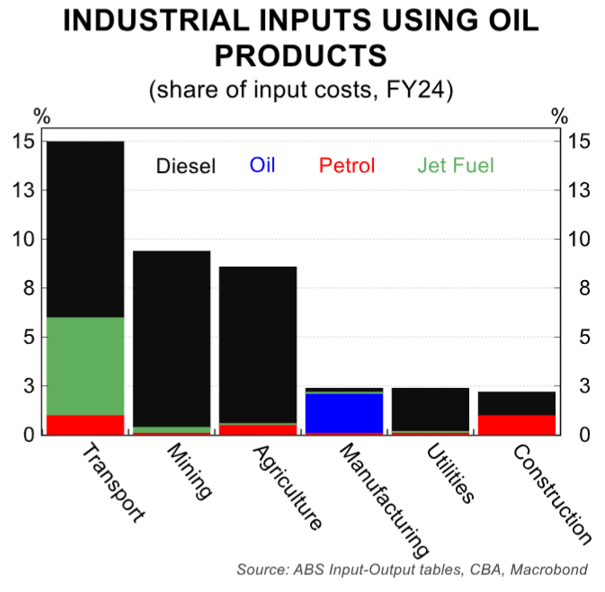
“These sectors are most exposed to imported refined petroleum product, particularly diesel”, CBA noted.
“We estimate that fuel products make up around 14% of transport industry input costs. Of this aggregate amount, diesel accounts for around 9% of the share of input costs with jet fuel at around 5% and petrol just 1%”.
“For the miners, we estimate that fuel costs –predominantly diesel –make up about 9% of the share of input costs with the diesel share at around 8% for agriculture. Petrol adds an extra 1% to this total”.
“All else being equal this implies that a near 10% increase in diesel, petrol and jet fuel prices could lift prices by 1% to 1.5% in these industries”, CBA wrote.
Thus, without adequate supplies of diesel, the Australian economy literally comes to a halt. Store shelves will go empty, crops will rot in the field, and mines will shutter.
Indeed, CBA estimates that a 10% reduction in fuel use (mostly diesel), due to possible supply shortages from the Middle East energy shock, could cost the mining sector around $14 billion, construction (around $13 billion), transport (around $12 billion) and agriculture (around $5 billion).
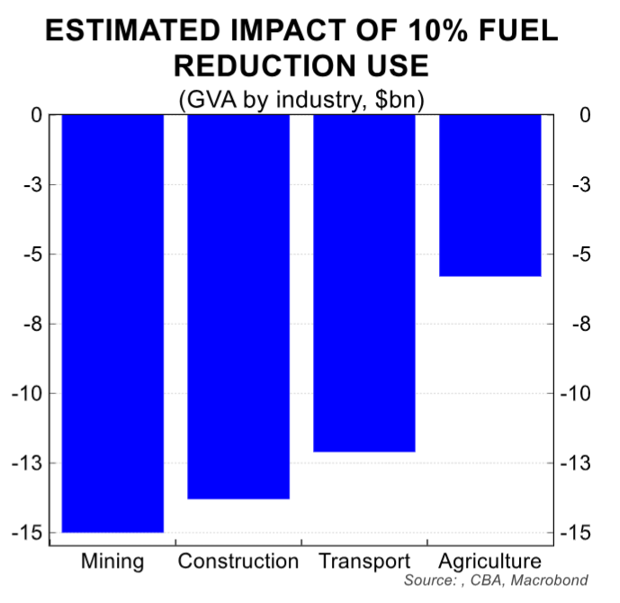
Steep rises in diesel costs will also quickly spill over into broader inflation via higher input costs.
The charts above show why the Australian government must prioritise energy security and resilience in the future.
Because without stable, affordable energy supplies, Australia cannot function effectively.