Climate Change and Energy Minister Chris Bowen is celebrating the tiny 0.4% decline in Australia’s transport emissions in the year to September 2025, which Bowen claims is “proof” that his government’s heavy subsidisation of battery electric vehicles (EVs) is working.
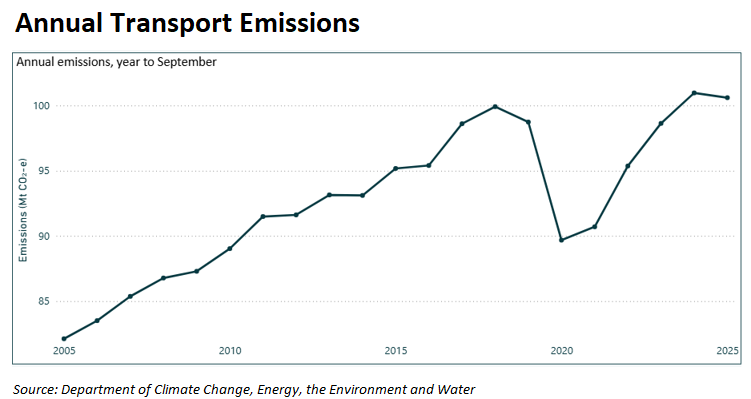
“We are on track to meet our climate targets if we stay the course and continue to lift our efforts”, Bowen said.
Official data from the Department of Climate Change and Energy shows that EVs accounted for a record 13% of all new cars sold in 2025, helped by subsidies. This is misleading.
The chart below shows that battery EV sales (green line below) failed to launch in 2025, with only 103,355 sold in the calendar year, comprising only 8.6% of total vehicle sales:
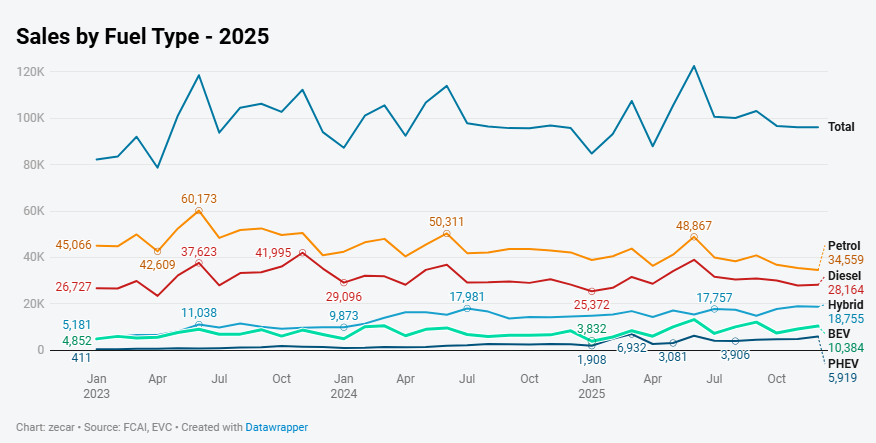
By contrast, sales of hybrid vehicles, which taxpayers do not subsidise, continued to grow strongly, reaching 252,655 in 2025, accounting for 21% of total vehicle sales.
Thus, around 2.5 times as many hybrids were sold as battery EVs, despite receiving no direct taxpayer subsidies.
The reality is that the federal government’s heavy subsidisation of battery EVs is highly wasteful and inequitable, and should be scrapped.
The FBT exemption on battery EVs can save a vehicle owner tens of thousands of dollars over several years and is projected to cost taxpayers $1.35 billion this financial year—15 times the original forecast.
Nearly half of the FBT tax breaks have gone to individuals earning more than $150,000, raising equity issues.
The Treasury forecasts that the total cost of the FBT exemption for battery EVs will rise to $9.7 billion between 2026-27 and 2029-30.
Battery EVs also qualify for a higher luxury car tax threshold, and several Australian states and territories offer direct subsidies, stamp duty exemptions, and registration discounts.
The operating costs of battery EVs are also subsidised, since they are exempt from road user charges via the 52.6 cents per litre fuel excise, which increases twice per year as part of the biannual CPI indexation.
The federal government receives $26.6 billion each year from excise and customs duties on petrol, diesel, and other fuel products.
The revenue it receives from the fuel excise will obviously decline as motorists switch from traditional combustion vehicles to battery EVs and hybrids. This lost revenue will need to be made up via other taxation or reduced spending on infrastructure and services.
Spending billions of taxpayer dollars annually to subsidise battery EVs for minimal carbon abatement is egregious.
Veteran budget watcher Chris Richardson encapsulated the idiocy perfectly in December when he described the FBT exemption for battery EVs as the “dumbest way ever” to reduce emissions.
“This is just outrageously expensive. This is about feel good rather than do good”, he told the AFR.
The Productivity Commission (PC) has also called for the scrapping of EV subsidies.
“Now that the Australian Government has implemented the New Vehicle Efficiency Standard, it should phase-out the exemption of electric vehicles from the Fringe Benefits Tax”, reads the PC said in a recent interim report.
Additionally, the report recommends, “state and territory governments should phase-out the exemption of electric vehicles from vehicle stamp duty and registration discounts”.
The PC noted that the FBT exemption is the most costly form of carbon abatement, costing between $987 and $20,084 per tonne:

Australia’s governments ought to stop wasting taxpayer money subsidising private vehicle purchases.
Wealthy inner-city residents receive most of these subsidies, exacerbating inequality. They also cost federal and state governments billions in foregone tax revenue as they grapple with mounting levels of debt.