Australia is experiencing a major economic shift driven by a decade-long surge in federal and state government spending:
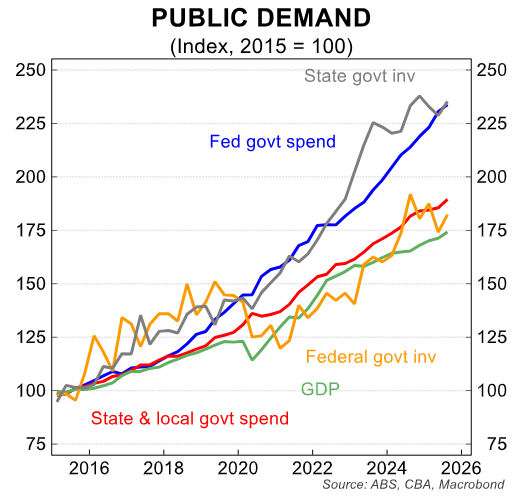
Economists claim government spending is now structurally reshaping the economy in a way comparable to the early‑2000s mining boom.
Alex Joiner, chief economist at IFM Investors, clearly illustrates the shift from the mining boom to the government-spending boom below.
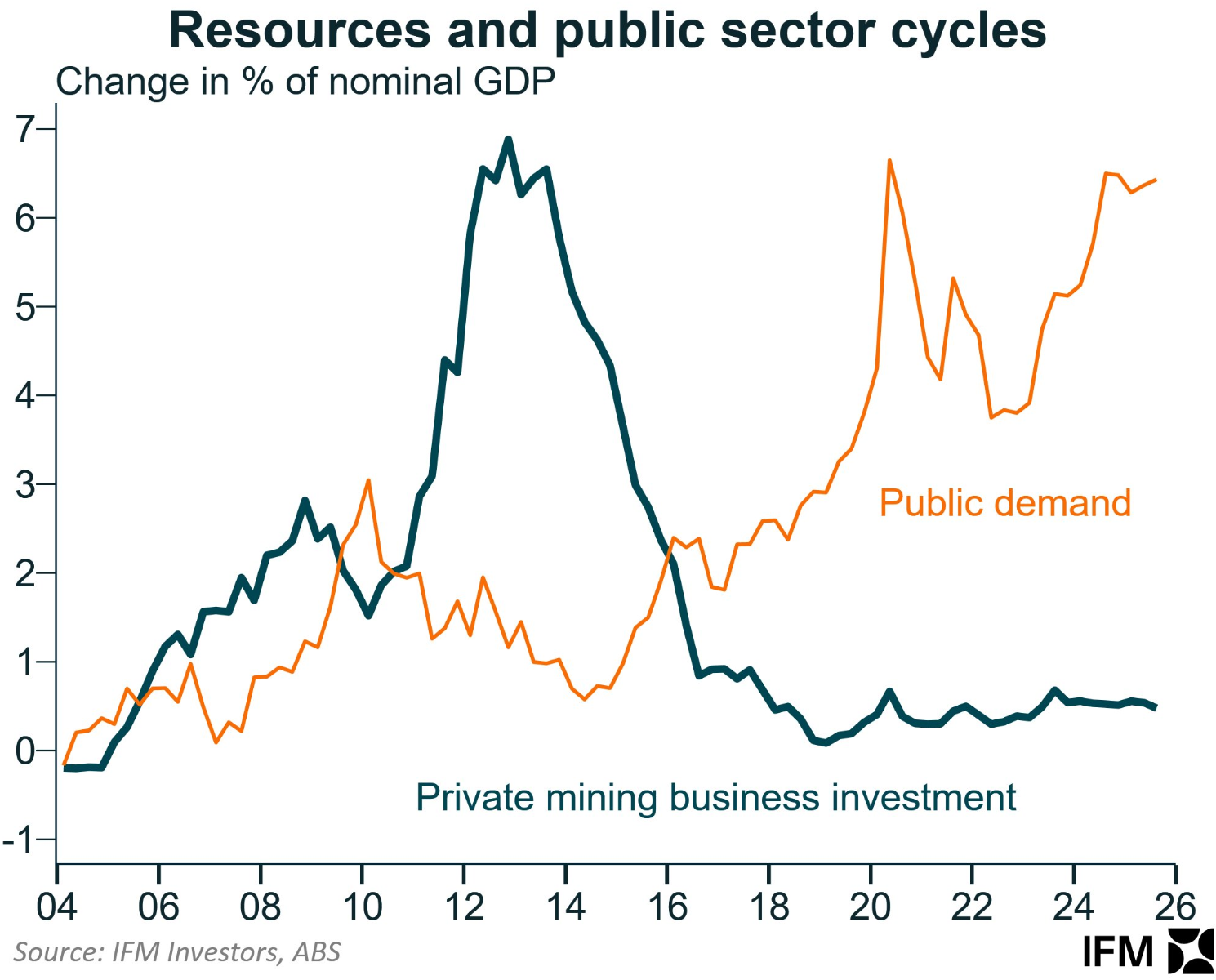
However, unlike the mining boom—which boosted productivity, tax revenue, and national income—today’s growth in public demand is being funded by taxpayers and is concentrated in less productive sectors such as health, aged care, and the NDIS.
Public demand now accounts for 28.5% of GDP, far above the pre‑pandemic average of 23.5%.
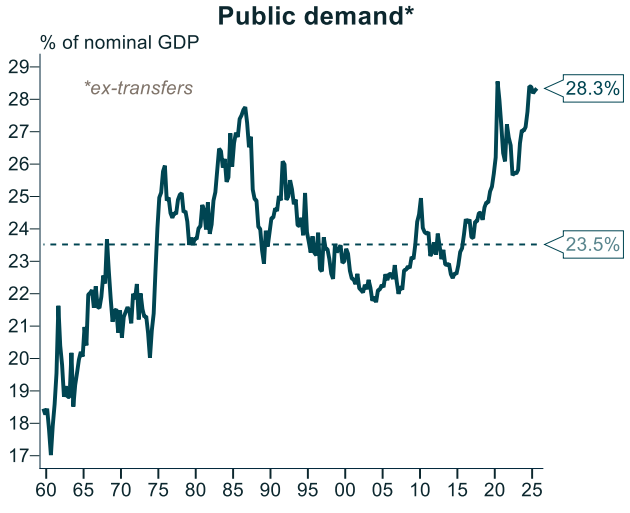
Chart by Alex Joiner at IFM Investors
This represents roughly $135 billion in additional annual spending compared to pre‑COVID levels.
Both Coalition and Labor governments contributed to this rise in spending over the past decade.
Care economy boom:
Since around 2013, spending on health, aged care, and disability services has surged.
The NDIS alone costs around $50 billion a year in expenditure and is projected to exceed $100 billion by 2035–36.
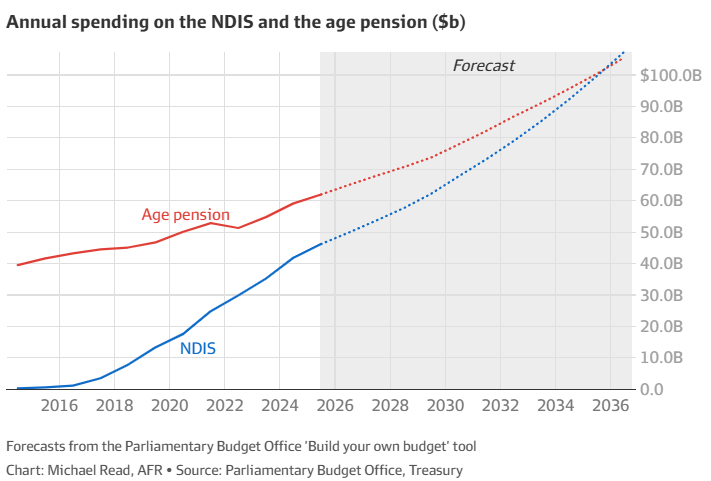
Chart from The AFR
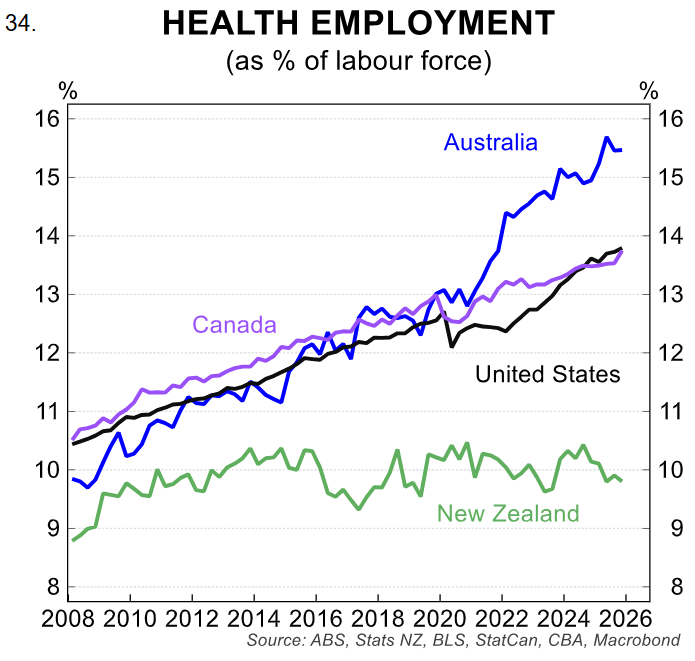
Australia now has a larger share of workers in health care and social services (i.e., 15.5%) than comparable countries like Canada, New Zealand, and the United States:
These non-market sectors have low productivity growth, contributing significantly to Australia’s six‑year productivity stagnation and sluggish per capita GDP growth:
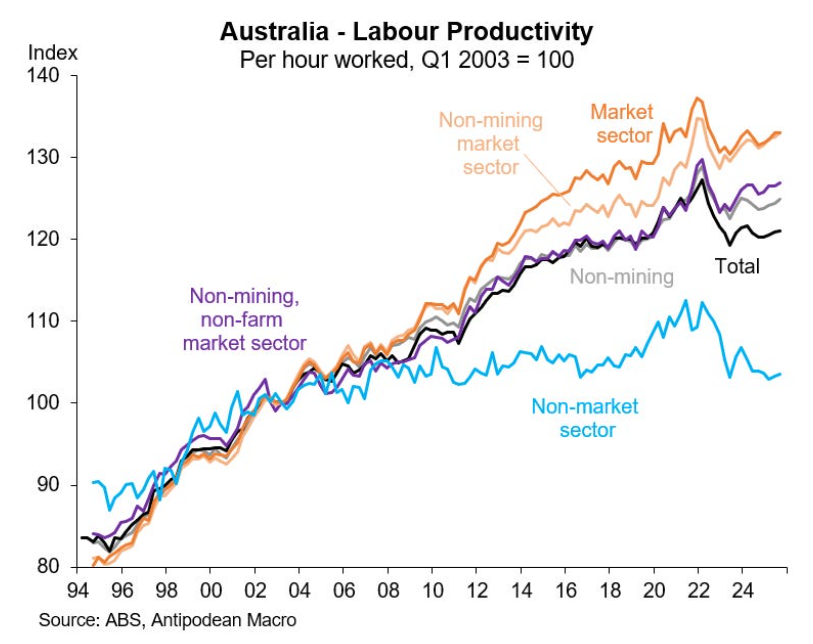
Chart by Justin Fabo at Antipodean Macro
Economists want governments to cut spending:
Economists told the Australian Financial Review that the level of public demand matters as much as its growth rate.
They argue that high public spending makes the economy more inflation-prone because government demand is less sensitive to interest rates.
As a result, the RBA must “work harder” and push interest rates higher to offset government-driven demand because public spending does not respond to rate hikes the way household spending does.
The economists also argue that the high public spending is “crowding out” the private sector by competing for labour and capital, pushing up costs.
In short, public spending has become a dominant driver of economic growth, and productivity has stalled at 2019 levels.
The Albanese government’s spending grew by 5.9% in 2024–25 and is forecast to be 4.5% this financial year. In comparison, economic growth has not exceeded 2.1% in over two years.
To reduce inflationary pressures, economists argue that public demand would need to fall to around 25% of GDP, requiring government spending to grow more slowly than the economy—something that hasn’t happened in three years.
My view:
Australia’s governments need to help the RBA by abolishing poor policies that push up inflation and crimp the nation’s productivity growth and supply potential, including:
- Excessive immigration
- Excessive and wasteful fiscal spending
- Gas and electricity market failures
The RBA should also be more vocal in calling out poor policy and holding our governments accountable.
Governments will have no incentive to behave responsibly so long as they can abrogate their economic management responsibilities to the RBA through the blunt tool of interest rates.